Explosive Dust in Silos and Storage Units: Risks and Prevention Measures
Understand the risks of explosive dust in silos, how explosions occur in storage units, and what measures help prevent accidents.

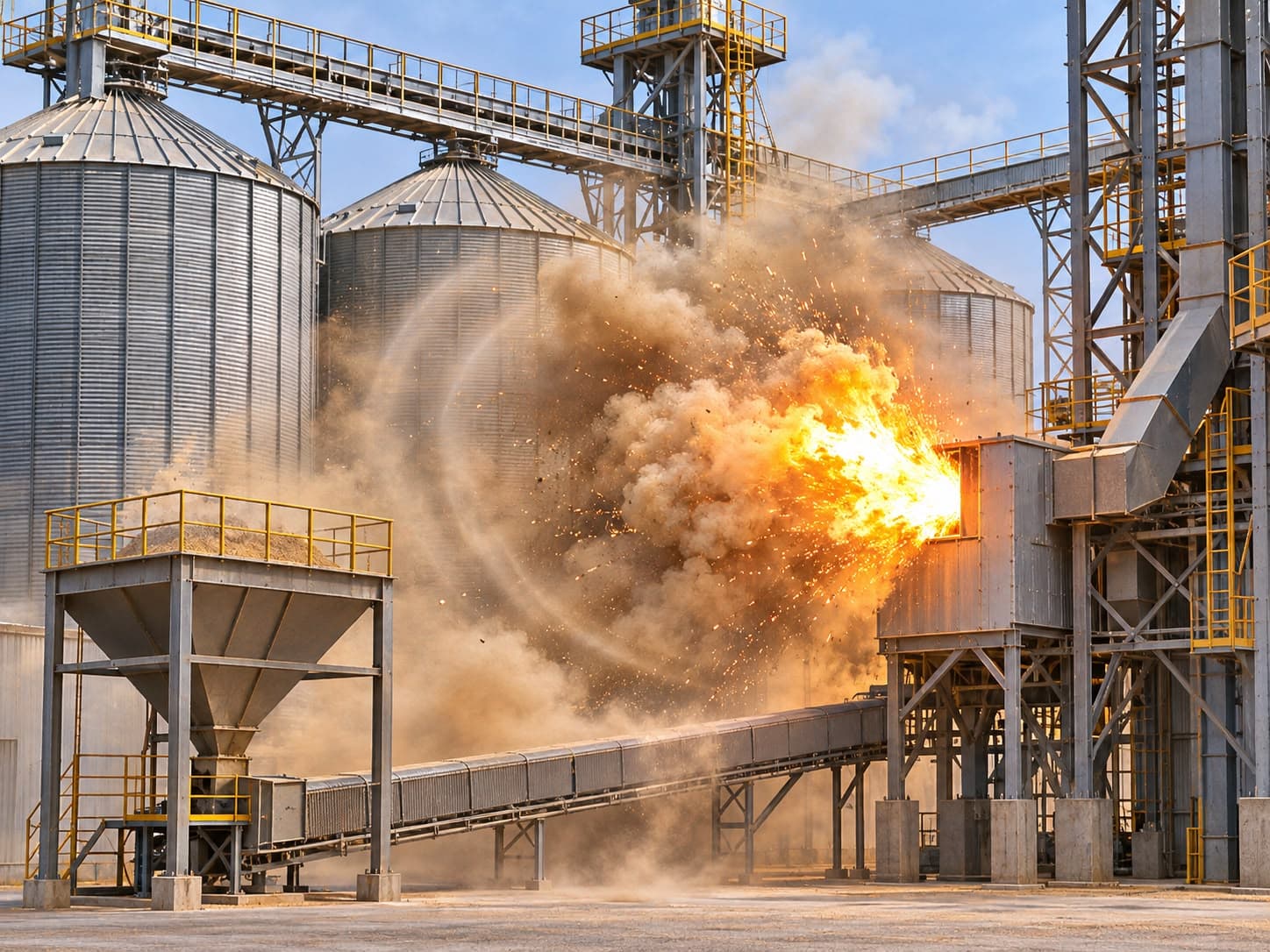
The storage and processing of grains are essential activities in the agribusiness production chain. However, operations such as receiving, unloading, cleaning, drying, transporting and grinding can generate combustible dust capable of forming explosive atmospheres. When dispersed in the air, at an adequate concentration and in the presence of a source of ignition, these particles can cause fires and explosions with serious consequences for workers, installations and the continuity of operations.
The risk is not restricted to the inside of the silos. Mugs, tunnels, mug lifts, conveyor belts, threads, filters, manifolds and galleries also require specific evaluation. The prevention must integrate engineering, maintenance, work procedures and emergency management measures.
How Dust Explosions Occur
The explosion of combustible dust depends on the simultaneous presence of finely divided combustible material, oxygen, dispersion of particles in the air, sufficient concentration and source of ignition. The confinement, common in industrial equipment and structures, can intensify the pressure increase and the damage resulting from the explosion.
During grain movement, friction and fragmentation generate particles that remain temporarily suspended or deposit on floors, beams, machines and pipes. A spark, overheated surface or flame can start combustion. The finer the dust and the more favorable the dispersion conditions, the easier the ignition and the faster the propagation.
Primary and Secondary Explosions
An initial explosion can occur inside an elevator, filter, conveyor, or other equipment. The resulting pressure wave can lift accumulated dust in nearby areas, creating new fuel clouds. If these clouds encounter the front of flame or another source of ignition, secondary explosions, potentially more destructive than the first, could occur.
The interconnection between equipment through ducts, galleries and transport systems allows the propagation of the event to other areas of the installation. Therefore, cleaning of deposited dust and explosion isolation devices are fundamental aspects of protection.
Main Sources of Ignition
Among the situations that can trigger the ignition of combustible dust, stand out:
• mechanical sparks caused by friction, impacts or contact of metal parts;
• overheating of misaligned bearings, bearings, motors and belts;
• welding, cutting and grinding services without proper control;
• electrostatic discharges and failures in electrical installations;
• open flames, hot surfaces, incandescent materials and spontaneous combustion of stored products.
Locations and Operations That Require Greater Attention
In the mucks and transfer points, the fall and the displacement of the grains favor the formation of dust clouds. In mug lifts and conveyors, misalignments, locking, friction and bearing failures can generate heat sources. In filters and collectors, the concentration of particles requires adequate protection systems. In tunnels and underground galleries, limited ventilation and difficulty in evacuation aggravate the consequences of an occurrence.
Silos, wells and other compartments may also have confined space conditions, according to their characteristics and technical evaluation. In addition to the risk of explosion, oxygen deficiency, hazardous gases, burial and rescue difficulties should be considered.
Preventive Measures and Engineering Controls
Effective prevention should prioritize the reduction of dust generation and accumulation, the elimination of ignition sources and the control of the consequences of a possible explosion. Priority actions include:
• install and maintain exhaustive local collection and ventilation systems at dust generation points;
• establish cleaning routines of floors, structures and equipment, using industrial aspiration methods appropriate to the risk and avoiding practices that resuspend dust;
• Preventively inspect bearings, motors, belts, alignments, conveyor systems and stopping devices;
• adopt temperature, speed, misalignment, capping and other monitoring devices as risk analysis;
• carry out evaluation of areas with possibility of explosive atmosphere and specify compatible equipment and facilities;
• verifying equipment potentialization, grounding and other electrostatic load control measures;
• technically evaluate systems for relief, suppression and isolation of explosions, observing the design and characteristics of dust;
• control hot services by formal authorization, area isolation, prior cleaning and fire prevention measures.
The selection of controls shall take into account tests and parameters of the effectively processed material, including minimum explosive concentration, minimum ignition energy, ignition temperature and explosion pressure characteristics. It is not appropriate to assume that the same system indiscriminately protects all types of dust.
Management of Workers' Safety and Protection
Physical measures need to be accompanied by documented procedures and training. Occupational risk management should include inspections, failure analysis, maintenance, hazardous energy blocking and labeling, contractor control, work permits, and emergency preparedness.
In spaces characterized as confined, the applicable requirements of NR-33, including atmospheric evaluation, entry control, surveillance, training and rescue planning, should be observed. The requirements of NR-31 for rural activities and storage facilities, NR-10 for electricity and NR-12 for safety in machinery and equipment should also be considered, as appropriate.
The use of personal protective equipment is complementary to collective protection measures and does not replace systems capable of preventing the formation or ignition of explosive atmospheres. In emergencies, the entrance for rescue should not occur in an improvised manner, due to the risks of suffocation, toxic gases, fire, explosion and burial.
Conclusions
Dusts originating from the reception, storage and processing of grains constitute a relevant risk, often underestimated for their routine appearance. The combination of dispersed combustible dust, ignition source and favorable conditions for propagation can produce successive explosions and severe damage.
The reduction of this risk depends on systematic inspections, technically adequate cleaning, localized exhaust, preventive maintenance, control of ignition sources and protective devices defined by engineering evaluation. Investing in these measures means saving lives, reducing material losses and ensuring greater reliability of storage operations.
Thank you for reading and until the next article.
Keep up with our weekly articles. For topic suggestions, please contact (42) 99997-4979.
Also read: https://bntonline.com.br/homem-se-finge-de-morto-en-cementerio-para-fugir-da-guarda-em-pg/