Viva the Patroness! Get to know a bit about the history of Our Lady of Aparecida
Aparecida is a symbol of faith and devotion for millions of Brazilians

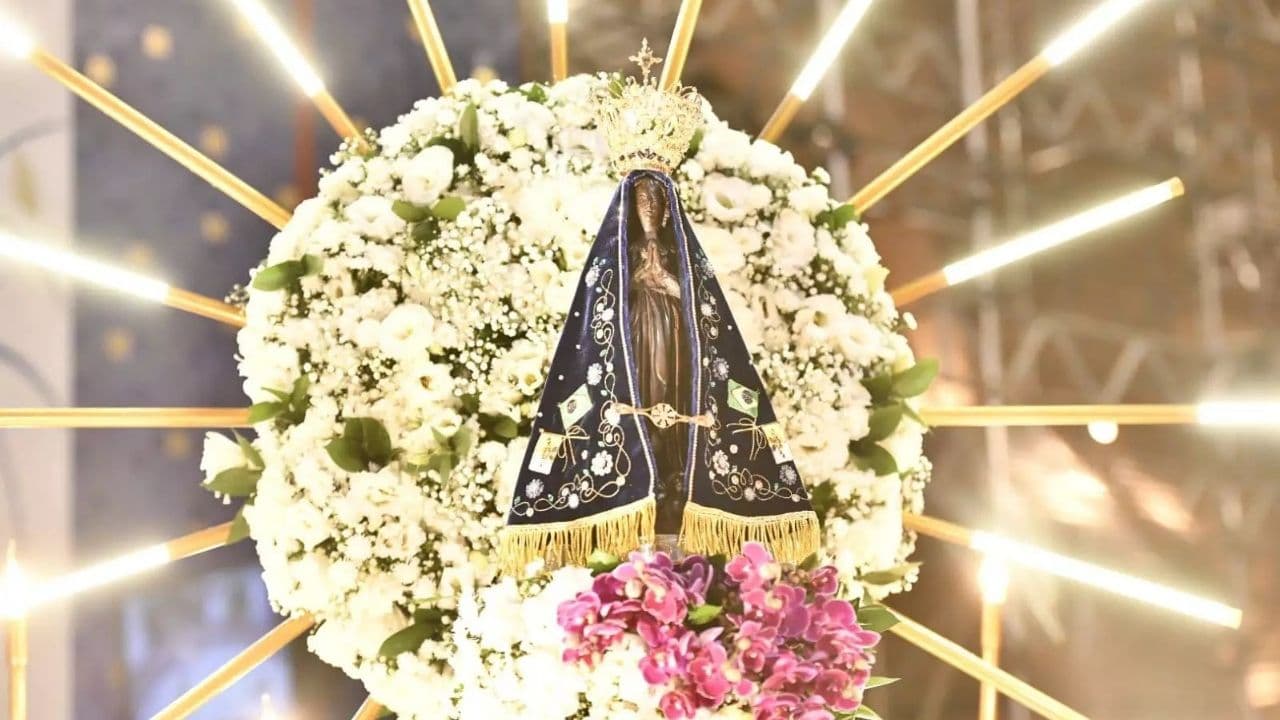
In 1717, Domingos Garcia, João Alves and Felipe Pedroso sailed the Rio Paraíba do Sul, in the state of São Paulo. After several unsuccessful fishing attempts, the men found an image of clay that was submerged. When they took it out of the water, they realized that it was an image of the Virgin Mary, more precisely, of the Immaculate Conception. They called her Aparecida.
The find was a milestone in the lives of fishermen, who began to report graces and miracles attributed to the intercession of the Virgin. The fame of the image spread, attracting devotees who came in pilgrimages from various parts of Brazil. More than two centuries later, in 1930, Pope Pius XI signed the decree that proclaimed Nossa Senhora Aparecida the patron saint of Brazil.
The solemn ceremony took place only in 1931, in Rio de Janeiro, then the federal capital, in front of about 1 million people. At the time, the pontifical decree declaring the Virgin Mary, under the title of Nossa Senhora of Conceição Aparecida, patroness of the Brazilian nation, was read publicly. On the same day, the flags of Brazil and the Vatican were added to the mantle that bears the image.
Decades later, in 1980, during the first visit of then Pope John Paul II to Brazil, October 12 was officially instituted as a national holiday in honor of the country’s patron saint. Since then, about 10 million pilgrims visit the National Shrine of Aparecida, in the state of São Paulo, every year, with the aim of renewing the faith and entrusting intentions to the Virgin Mary.
For Bishop Vilson Dias de Oliveira, emeritus bishop of Limeira (SP) and member of the National Conference of Bishops of Brazil (CNBB), the solemnity of Nossa Senhora of Conceição Aparecida transcends the borders of Brazilian territory and presents itself as a “spiritual beacon” on the horizon of universal Catholicism. In his letter, he highlights the saint’s concern for the little and the poor.
“The discovery of the small image in the waters of the Rio Paraíba do Sul has not only opened a chapter in the history of the national faith, but has inscribed in the patrimony of the Church a profoundly theological event: the manifestation of Mary’s concern for the little ones, for the discarded and for the continents that seek their liberation and unity in the Gospel of Christ,” he wrote.
The religious assesses that, for Latin America as a whole, devotion to Nossa Senhora Aparecida has “singular and prophetic resonance.”
“The Latin American continent, marked by historical wounds of inequality, but illuminated by a fervent popular piety, finds in the black clay Virgin the living expression of the face of the continental Church itself.”
In the document, the bishop emeritus evaluates that the figure of the Virgin Aparecida attests to the world that God prefers to manifest his greatness through what is fragile and humble. The small broken image, gathered from the bottom of the waters by the hands of simple fishermen, according to him, recalls that true evangelization “is born of love embodied in the concrete reality of peoples and their cultures”.
“May the communities scattered throughout Brazil and the sister countries of Latin America not be afraid to take this bold step. Faced with the social, economic and spiritual challenges that mark our time, the Virgin Aparecida reminds us that God continues to perform his greatest wonders through the humble and organized in community,” concluded Bishop Vilson Dias de Oliveira.
With information Agência Brasil
Also read: Young man is injured in a car crash in the back of a truck on BR-376