Camber approves new neighborhood of 8.5 million square meters in Ponta Grossa
Ponta Grossa Chamber approves project for new planned neighborhood of 8.5 million square meters near Sant'Ana Airport. Check the details

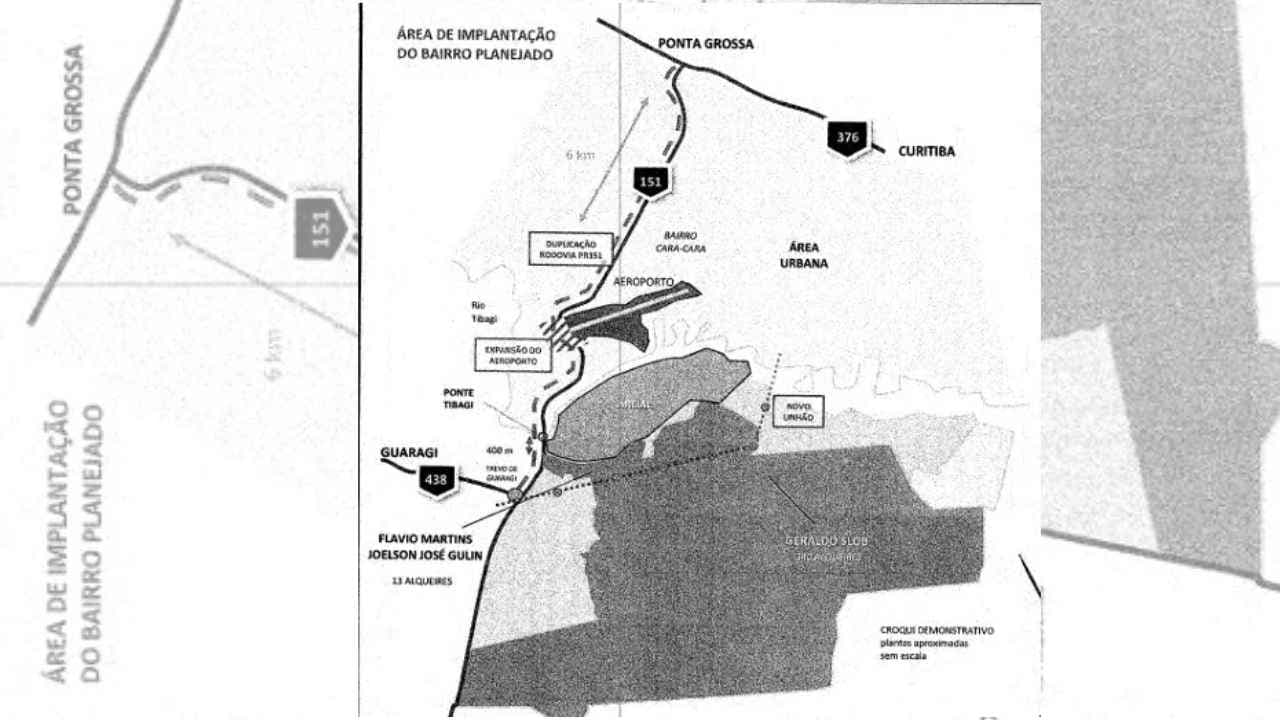
The Câmara Municipal de Ponta Grossa approved, on Wednesday (18), the Bill No. 399/2025, which allows the inclusion of an area of 8.5 million square meters in the urban perimeter of the municipality. The change paves the way for the implementation of a new neighborhood planned in the vicinity of Sant'Ana Airport, in the region of PR-151, Palmeira direction.
The proposal was approved in two votes, held during ordinary and extraordinary sessions, and now goes to sanction of prefeita Elizabeth Silveira Schmidt.
The project, presented by Construtora Piacentini in partnership with landowners in the region, provides for the implementation of a smart city neighborhood, bringing together housing, commercial establishments, services, green areas and public facilities.
The property is currently classified as a rural area. With the approval of the project, they integrate an Isolated Urban Area, framed as Mixed Zone 2 (ZM2), allowing them to advance the necessary procedures for the urban parcelling of the soil.
Where will the new neighborhood of Ponta Grossa be?
The new planned neighborhood will be located near Sant'Ana Airport – Comandante Antônio Amilton Beraldo, in the PR-151 region, which connects Ponta Grossa to Palmeira.
According to the documentation presented by the entrepreneurs, access to the development will be located approximately 400 meters from the current urban perimeter.
The area is located in a region close to Rio Tibagi, the Tibagi Bridge and the access clover to the district of Guaragi, by PR-438.
In total, the project includes six real estate registrations, which total approximately 850 hectares, equivalent to 8.5 million square meters.
The land belongs to Geraldo Slob, Flavio Percy Lopes Martins and Joelson José Gulin, who participate in the proposal in partnership with Construtora Piacentini.
Neighborhood will have smart city concept
The project presented by the entrepreneurs envisages an urban occupation model based on the principles of sustainability, innovation, mobility and quality of life.
The proposal is aligned with the urban development concept of Ponta Grossa 2050 and seeks to integrate different activities in the same territory.
Among the planned structures are residential areas, commercial spaces, services and industrial activities of low impact, in addition to equipment aimed at education, health, culture and leisure.
The intention is that future residents have access to essential services, job opportunities and leisure options within the neighborhood itself, reducing the need for large displacements.
The enterprise also provides for the enhancement of green areas and the creation of public spaces for coexistence.
What is planned in the infrastructure?
According to the proposal presented, the planned neighborhood should have sustainable infrastructure solutions and technologies aimed at improving urban services.
Among the main structures and initiatives planned are:
Mobility: wide and wooded streets, accessible sidewalks, bike paths and integration with public transport.
Renewable energy: use of solar and wind power generation systems.
Public lighting: implementation of LED luminaires with the possibility of powering by photovoltaic energy.
Free internet: connectivity in public spaces, bus stops and community equipment.
Water resources: systems for water collection, distribution and reuse.
Waste management: selective collection, recycling and reuse of materials.
Safety: monitoring systems integrated with public equipment.
Leisure: implementation of parks, squares, lakes, bike paths, hiking trails, outdoor gyms and cultural spaces.
Also mentioned are structures such as daycare centres, libraries, community centers and facilities for attending the population.
These characteristics integrate the conceptual proposal of the enterprise and will still depend on technical projects and their respective approvals.
Why was the airport chosen?
According to those responsible for the proposal, the location was chosen because of the potential for economic and urban growth of the region.
The venture will be close to major public and private investments planned or under development in Ponta Grossa.
Among them are the duplication of PR-151, road interventions in the industrial region, the expansion of Sant'Ana Airport and projects to expand the sanitation and energy infrastructure.
The proximity to industries and logistics enterprises is also pointed out as a strategic factor to attract residents, companies and investors.
The entrepreneurs argue that the new neighborhood can contribute to the generation of jobs, the strengthening of trade and the expansion of the municipal collection.
What was approved by the House?
The Bill No. 399/2025 authorizes the inclusion of the six properties in the urban perimeter of Ponta Grossa, establishing the classification of Isolated Urban Area and the framing in Mixed Zone 2.
In the justification sent to the Legislative in October 2025, the City Council informed that the proposal was analyzed within the administrative protocol SEI no 34494/2020.
The documentation also records that the enterprise passed through audiência pública and evaluation of the City Council, with favorable demonstrations.
Before the vote in plenary, the matter received favourable opinions from standing committees of the Câmara Municipal.
The approval represents an important step for the advancement of the enterprise, but it does not mean that the implementation of the neighborhood is definitely authorized.
When do the works of the new neighborhood begin?
There is not yet a date for the start of the works.
With the approval in the two discussions held on Wednesday (18), the project is being analyzed and eventually sanctioned by prefeita Elizabeth Schmidt.
After the publication of the law, other administrative and technical steps will still be necessary, including detailed urban planning, environmental licensing, infrastructure projects and the approval of land parcels.
The conditions of water supply, sewage collection and treatment, electricity supply, road system and mobility should also be evaluated.
Therefore, the decision of the Chamber allows progress in the legal transformation of the rural area into an urban area, but does not authorize the immediate start of construction.
The enterprise must still meet the urban, environmental and legal requirements before leaving the role.
Asphalt in 23 villages of PG: Mabel charges R$ 100 million