Collection Inspired by Mexico Highlights Handicraft and Income Generation in PG
Mexican Collection from Ateliê Transitória Unites Handmade Pieces Produced by Women from Casa Transitória in Ponta Grossa

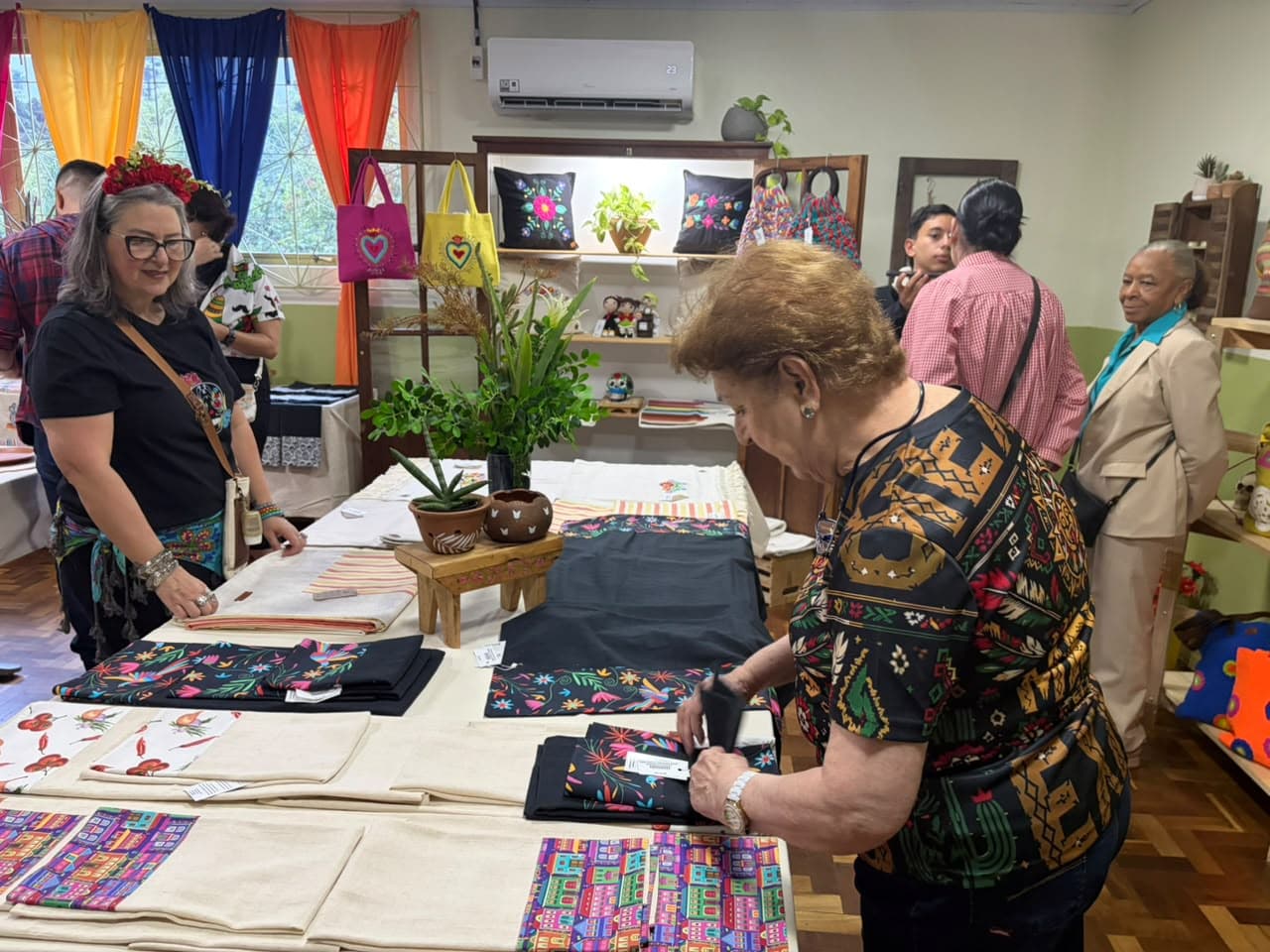
A new collection marked by colours, artisan techniques and references to Mexican culture was launched on Thursday (1st) by Ateliê Transitória, a project linked to the Fabiana Transitional House of Jesus, in Ponta Grossa.
The edition brings together pieces produced in a totally artisanal way by the women who participate in the activities of the institution. Among the products are dish cloths, rugs, carpets, blankets, ceramics, bags made by upcycling, crochet towels and dolls, known as amigurumis.
The Mexico collection continues a series of thematic productions already developed by the workshop. In other editions, the artisans sought inspiration in countries and regions such as Japan, France, Italy and the Amazon.
Crafts gain new possibilities
According to the coordinator of the Transitional House, Ana Paula Rocha, one of the proposals of the collections is to show the public new possibilities for manual work.
“The goal of working with the collections is precisely that, we diversify the artisan product so that we can bring another look on what this artisan process is,” he explains.
The complexity involved in the production also appears in the details of the parts. Some require days or even weeks of dedication.
“There’s a blanket that was made in the crochet, it had 44,000 stitches made by hand. So how rich is the craftsmanship, how much women really strive and work to perform these pieces that are wonderful,” highlights Ana Paula.
For the coordinator, the collections also help to break the idea that craftsmanship is limited only to more traditional products.
“The great importance for us is just to show that artisanal work can come out of that commonplace, from that everyday life, that sometimes we see only a rug, only a simpler product, then we can translate this artisanal wealth into the making of a crochet bag, of a crochet scale...”, he says.
Project also promotes income generation
The artisanal production is directly related to one of the fronts of action of the Transitional House. Currently, the entity develops work focused on food security, income generation and healthy aging.
“The Transitional House we have three lines of action, which one is food security, the other is the generation of income and healthy aging. In the generation of income, usually it is our women who are elderly, who end up coming to a coexistence program and those who end up wanting to participate in the collection, the production processes, even to increase their income”, explains Ana Paula.
In addition to the financial aspect, the project also seeks to take advantage of the materials received through donations, reducing waste and incorporating sustainability into the production process.
“The importance of working with the collections is also because we have received many donations and this makes us work with a color palette and there is no waste of material. [...] The collection also has this issue of financial sustainability, sustainability also ecological by virtue of the type of product that we use”, he adds.
Conversation and exchange of experiences
For artisans, work also represents a space for coexistence, learning and integration.
Dona Nolair participates in the production of crocheted pieces and tells that she produced bags and amigurumis for the new collection.
“I’m part of the crochet. So I made the bags... there are these amigurumis here too, I love to do, which comes out well contested. Then we make only one piece of each, so we stay here waiting to see who will take it,” he says.
Each product, according to her, is prepared taking into account also the person who can take it home.
“We do it with a lot of affection because we know that people will come and they will like the play that we did,” he says.
Participation in the project exceeds artisanal production. For Ms. Nolair, dating also makes a difference in women’s routine.
“I love coming here, because I come on Monday and Wednesday, we have a conviviality with many women, each with their problem and we go talking and spend the afternoon that is a beauty.”
“We take the opportunity to learn and teach what we do. So we are here to have a better fun, a better life for us.”
Part of the production is carried out by artisans at home, especially in the works that require more concentration and precision.
“We take the material here and take it home to do it, because here there is no time to do it. Here we teach one, teach another, talk with one, talk with another... And we have to count point by point. So you can't lose your career points because if you lose you can't do it. So I take it home and do it at home calmly,” he reports.
Exhibition continues during October
During the launch month, the collection inspired by Mexico can be visited from Monday to Saturday, from 2 p.m. to 7 p.m.
After the special exhibition period, the pieces that will be available will continue to be marketed in the permanent store maintained within the Fabiana Transitional House of Jesus.
The institution is located at Rua Afonso Celso, in the region of Ana Rita, at Ponta Grossa.