Majority that used relatives in the ballot name did not get elected
Of the 39 candidates who incorporated references to other people in their ballot names in the 2026 elections, only eight won mandates. Most cited relatives, such as parents, husbands, and mothers. The survey was conducted by g1 based on records from TSE.

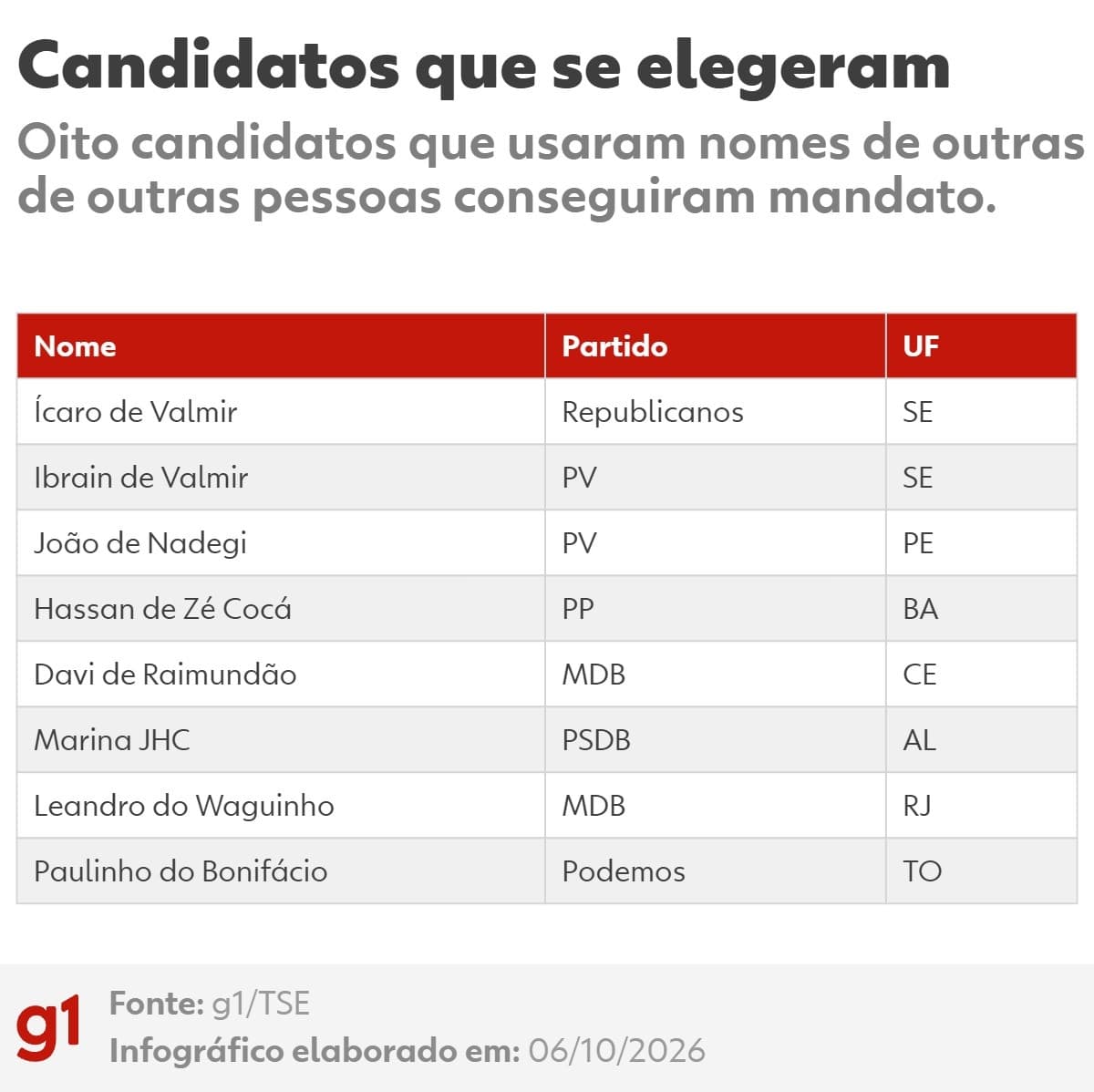
A G1 survey, based on the nominations registered in the Superior Electoral Court (TSE), revealed that most candidates who used names of relatives or political allies in the name of the ballot box failed to elect themselves in the 2026 elections. Of the 39 candidates identified, only eight were elected, while 31 were left out.
The practice of incorporating references to other people in the name of the ballot box is common in electoral campaigns, but the numbers show that the strategy does not guarantee success in the ballot boxes. The survey considered candidates who made mention of family members, political allies or other people in their campaign names.
Strategy does not guarantee victory
Of the 39 candidates analyzed, 32 referred to family members and two to political allies. In five other cases, it was not possible to confirm the relationship between the candidate and the person mentioned in the ballot box. Among the 32 cases of kinship identified, 14 candidates mentioned their fathers; 11 candidates mentioned their husbands; three mentioned their children; and three mentioned their mothers. In one case, it was not possible to determine whether the reference was to the father or mother.
Sixteen candidates did so for the first time this year, while the others had already adopted the strategy in previous elections. Despite the recurrence, the electoral result shows that association with known names is not enough to guarantee a mandate.
Who were the elect
Among the eight winners, seven already had a political trajectory before the election. Ícaro de Valmir (Republicans-SE) was re-elected federal deputy by Sergipe. He is the son of Valmir de Francisquinho (Republicans), who also refers to his father in the name of urn, and was a candidate for the state government, but lost the dispute to the current governor Fábio Mitidieri (PSD).
In the same state, Ibrain de Valmir, son of the political leadership Valmir Monteiro, was re-elected state deputy. In Pernambuco, João de Nadegi, son of the former mayor of Camaragibe Nadegi Queiroz, also managed to win re-election for state deputy.
In Bahia, Hassan de Zé Cocá was re-elected as a state deputy. Unlike most cases of the survey, the reference in his name is not to a relative, but to the political ally Zenildo Brandão Santana, the Zé Cocá, former mayor of Jequié. In Rio de Janeiro, the former municipal secretary of Belford Roxo, Leandro do Waguinho (MDB-RJ), was elected state deputy. He also used the name of a political ally, Wagner dos Santos Carneiro, the Waguinho, former mayor of the municipality.
In Ceará, Davi de Raimundão, son of Raimundo Macedo, former mayor of Juazeiro do Norte and former deputy, was re-elected state deputy. Complete the list of elected members Paulinho do Bonifácio, elected state deputy in Tocantins. He already had a political trajectory and makes reference in the name of the urn to his father, José Bonifácio, who was a political leader in northern Tocantins.
Unique debutant
The only newcomer among the elected ones who used the strategy of using the names of other people is Marina JHC (PSDB-AL), wife of João Henrique Caldas, the JHC, elected governor of Alagoas. She won a seat in the Senate. Marina had no previous elective term, but her family connection to the elected governor may have influenced the electorate.
Defeat of experienced candidates
In Rio de Janeiro, two names with experience in elective positions were left out. Daniela do Waguinho (Republicans) was not re-elected as a federal deputy. She used the nickname of her husband, former mayor of Belford Purple. The same happened with the former mayor Lívia de Chiquinho (Republicanos), former mayor of Araruama, candidate for federal deputy. She made reference to her husband, Francisco Carlos Fernandes Ribeiro, the Chiquinho da Educação, also a former mayor of the municipality.
In addition to Valmir de Francisquinho, who lost the dispute to the government of Sergipe, Sérgio de Nalva (Avante), who was secretary of Public Services of Cabo de Santo Agostinho, in Pernambuco, was also not elected. In the name of the urn, he refers to his mother, Nalva, who owns a store in the municipality.
Standards in references
In the five cases where the link could not be confirmed, the names have characteristics of possible patronymics — names formed from the reference to an ancestor. Of the 11 candidates who make reference to the husband, ten use the prepositions “of” or “of”, constructions that refer to the idea of possession.
The survey of the g1 shows that, although the practice is common, electoral success depends on other factors, such as the political trajectory of the candidate and the strength of the name cited. Most of the elected officials already had a previous mandate or political experience, suggesting that reference to third parties works more as a reinforcement of an already established brand than as a shortcut for new candidates.
Read Also
91-year-old oldest female MP elected in 2026 makes history at the polls
Government wants to expose Flavio's allies in debate on ending the 6×1 scale
Flávio Bolsonaro seeks to expand base in the second round
Font
g1.globo.com