Paraná Police Science Department receives unprecedented equipment against counterfeiting
Despite the installation, the routine use of the device still depends on the implementation and validation of analysis methodologies

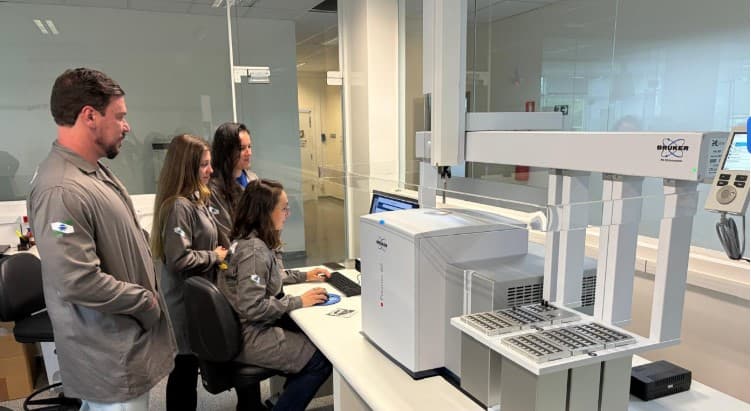
The Scientific Police of Paraná (PCIPR) has an unprecedented equipment among Brazilian state scientific police, capable of assisting in the identification of drugs, drugs and counterfeit or adulterated products. The technology can also be used to analyze wines, olive oils and alcoholic beverages, contributing to criminal investigations and laboratory tests.
The device, called Bruker Fourier 80, was installed in the Forensic Chemistry Section and uses the Nuclear Magnetic Resonance (NMR) technique. The investment was approximately R$ 2 million, with resources passed on entirely by the State Lottery of Paraná (Lotopar).
With the acquisition, the Paraná becomes the first Brazilian state to incorporate this technology into the structure of its Scientific Police. Until then, within the scope of the country’s official expertise, the equipment was used only by the Federal Police.
Technology allows to identify substances and tampering
The Nuclear Magnetic Resonance spectrometer allows to study the molecular structure of different substances, providing information that helps in the identification of chemical compounds and in the analysis of mixtures.
In practice, the technology could be used to identify illicit drugs, new psychoactive substances, drugs, solvents and materials of unknown composition.
Another important application is in the investigation of possible falsifications and tamperings of alimentos e bebidas. The equipment can identify differences in the chemical composition of products such as wines, olive oils and alcoholic beverages, providing technical data for the expertise.
According to the Director General of the Scientific Police of Paraná, Ciro Pimenta, the acquisition represents an advance in the production of scientific evidence used in criminal investigations.
“It broadens the scope of expert examinations and offers new possibilities for the identification and characterization of substances. We strengthen the production of technical and scientific evidence and expand the support to criminal proceedings, contributing to the authorities have qualified information for the correct elucidation of cases, "he said.
Exams may gain more accuracy
The new technology will also be able to optimize certain laboratory procedures and assist experts in choosing complementary examinations, depending on the characteristics of the samples analyzed.
The head of Forensic Chemistry of PCIPR, Gabriela de Moraes Pinto, explains that the equipment expands the possibilities of investigation and works as a complementary tool to the methods already used by the institution.
“It can be used in the identification of drugs, drugs, solvents and unknown substances, as well as helping in the analysis of mixtures. It is a tool that complements the equipment already existing in the laboratory and expands our research possibilities, allowing more complete analyses and more reliable results,” he said.
Despite the installation, the routine use of the apparatus still depends on the implementation and validation of the analysis methodologies, in addition to the training of the professionals responsible for the operation.
Investment strengthens forensic science in Paraná
For the general coordinator of NAPI Public Security and Forensic Sciences and director of the Exact Sciences Sector of the Federal University of Paraná (UFPR), Caroline Da Ros, the investment represents a milestone in the modernization of Brazilian criminal expertise.
The technology also opens possibilities for scientific collaboration between institutions, including through the integration into a national network of nuclear magnetic resonance.
This integration may favor the sharing of knowledge and increase the ability to respond to investigations that require specialized chemical analysis.
The acquisition of the equipment was fully financed with Lotopar resources and is part of the technological modernization process of the Scientific Police of Paraná.
With the new structure, the institution expands its potential for producing technical-scientific evidence and strengthens support for criminal investigations conducted in different regions of the state, including Ponta Grossa and Campos Gerais.
Read also Aid-disease: INSS creates 10-day deadline to challenge denied benefit