Police Civil of Mallet investigates author of audio inciting rape against petistas
Police Civil of Mallet investigates person for incitement to crime after audios against petistas. Find out what penalty is provided by legislation.

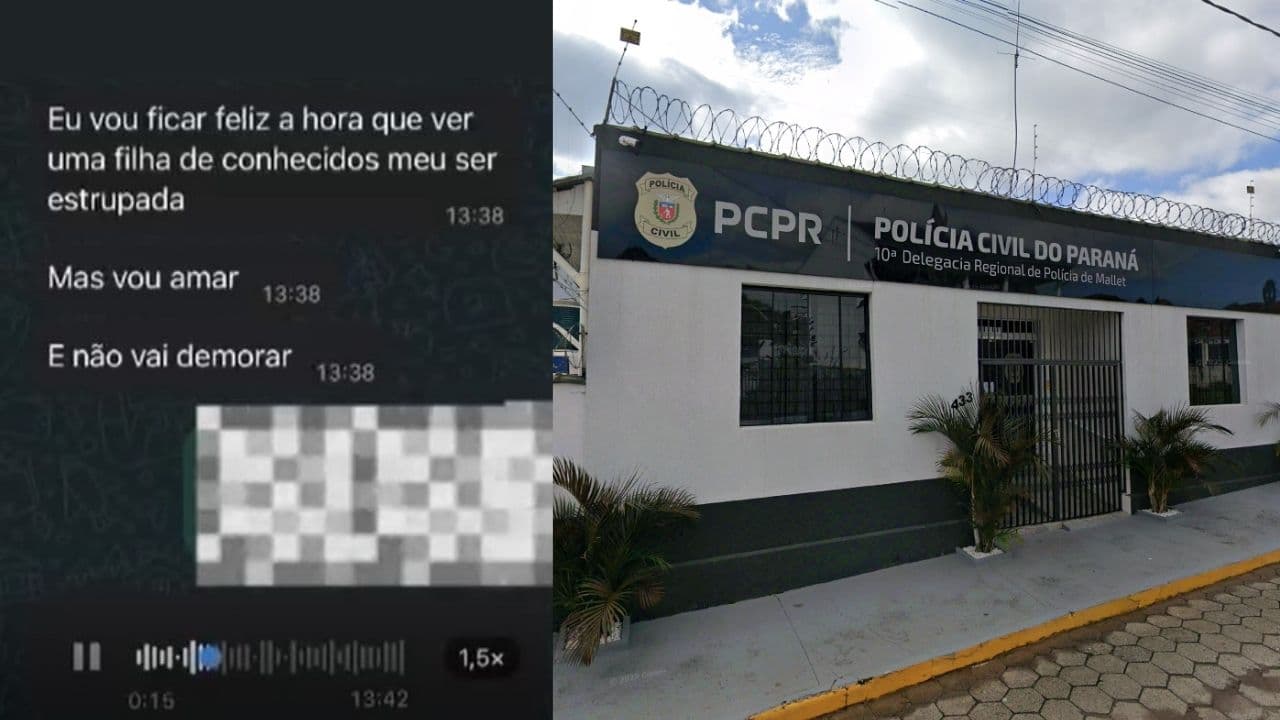
The Mallet Civil Police, in Paraná, confirmed that a person is being investigated for the crime of incitement to crime, after the circulation of audios with violent statements against voters of the Workers' Party (PT). The recordings, which include references to rape and attacks on people for their political preferences, provoked outrage among residents of the municipality after the second round of the 2026 presidential elections.
The information was confirmed to BnT Online on Thursday by Mallet’s Civil Police delegate, Thiers Andregotti, who said the case is under investigation.
“Good afternoon, the person in question is being investigated for incitement to crime,” the delegate said.
The confirmation represents a new unfolding of the case, revealed by BnT Online on Wednesday, when the portal published a report on the recordings circulating in message groups and social networks.
“What rapes, what tears”: remember the case
In one of the recordings released, a woman expresses anger at the result of the presidential elections and uses expressions that refer to sexual violence.
“May God bless, rape, tear,” the voice says in the audio, before wishing suffering to people who would have contributed to the election result.
The statements provoked protests on social media, especially for the use of sexual violence in a speech of political hostility.
In another recording, attributed to a resident of the municipality, possible vandalism actions against vehicles belonging to PT voters are mentioned.
The woman says that if she has the opportunity, she can break mirrors and flashlights of cars identified as belonging to petistas.
To date, there is no confirmation that the acts of violence and vandalism mentioned in the recordings have been effectively practiced.
The previous report also showed the circulation of lists of commercial establishments classified according to the supposed political preferences of their owners, a situation that widened the tension between residents and merchants of the city.
What is incitement to crime and what is the intended penalty?
The crime of incitement to crime is provided for in article 286 of the Brazilian Penal Code and consists of publicly encouraging other people to commit a criminal offence.
The legislation establishes the following punishment:
Detention of three to six months or fine.
This means that a person convicted of incitement to crime may receive a prison sentence or a financial penalty, depending on the court decision and the circumstances of the case.
To characterize the crime, it is necessary to evaluate whether there was an effective public incentive to commit a crime. The mere expression of opinion, even if offensive or controversial, does not automatically set up incitement to crime.
In the case of Mallet, it will be up to the Civil Police to analyze the content of the recordings, the authorship, the context of the demonstrations and the other elements necessary to determine if the conduct investigated falls within the scope of article 286.
The confirmation of the investigation does not mean that the person involved has been indicted, denounced by the Public Prosecutor’s Office or convicted by the Justice.
Investigation may result in criminal liability
With the investigation underway, the Civil Police will be able to gather elements to clarify the circumstances in which the statements were made and identify possible criminal responsibility.
If sufficient evidence is identified, the procedure may be referred to the Public Prosecutor’s Office, which is responsible for evaluating the appropriate judicial measures, including the possible offering of a complaint.
As it is an infraction with a maximum sentence of less than two years, the crime of incitement to crime is, as a rule, considered to have less offensive potential. The legislation admits, when the legal requirements are met, mechanisms such as criminal transaction and other measures applicable to Special Criminal Courts.
This does not mean lack of accountability. The application of these measures depends on the analysis of the specific case and the conditions provided for by law.
Any other violations, such as threat or damage to property, would require specific analysis and were not confirmed by the delegate as the subject of the investigation reported to BnT Online.
How to report threats and encourage violence?
People who receive messages with possible threats or encouragement to commit crimes can seek out the Civil Police and submit the material for analysis.
To contribute to an investigation, it is important to preserve the original audios, messages, dates, information about the context and other records that can help in identifying the author.
The complaints can be sent to the Civil Police by phone 197 or to the Disque-Denuncia 181. In situations of immediate threat or crimes in progress, the orientation is to activate the Military Police by 190.
The recommendation is to avoid the disclosure of personal information of suspects on social networks, preserving the work of authorities and preventing unproven charges.
The case is still under investigation
The confirmation of the investigation by the Civil Police marks a new stage of the episode that has gained repercussions in Mallet.
The case also reignites the debate on the limits of freedom of expression, responsibility for content shared in messaging applications and the legal consequences of demonstrations that may encourage violence due to political divergences.
The BnT Online will continue to follow the developments of the investigation and maintains open space for the manifestation of the person investigated and their possible defense.
Read also: “Let it rape, let it tear”; audios against petistas generate revolt in Mallet