Sergio Moro asserts to Fiep board that industry will have strategic role in his government
During a meeting at the Industry Campus, on Thursday (28), the elected governor of Paraná, Sergio Moro, presented priorities for his administration and promised to maintain permanent dialogue with the state's productive sector.

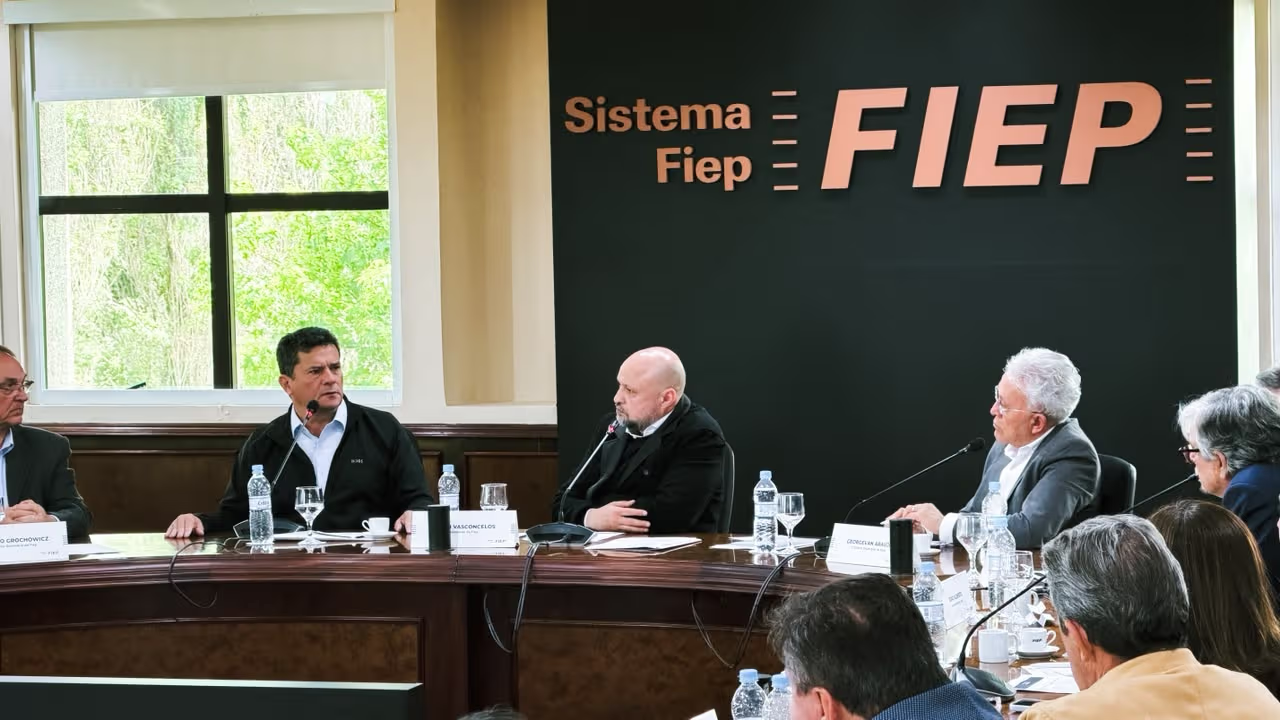
The board of the Federation of Industries of Paraná (Fiep) received, on Wednesday (28), the elected governor of the State, Sergio Moro. At the meeting, held at the Industry Campus, in Curitiba, Moro presented some of the priorities of his management, stressing that the strengthening of the industrial sector is strategic for Paraná’s economic growth. Among other topics discussed at the meeting, led by the president of the Fiep System, Edson Vasconcelos – who is also the elected deputy governor of Paraná –, he also spoke about the assembly of his government team and stated that his management will maintain an institutional relationship with the federal government, always in defense of Paraná.
“I am very happy that we were successful (in the election) and we intend to fulfill all those commitments that we have made, seeking to make our Paraná, within this universe of Brazil, an example, a model of something different from Brasilia,” said the elected governor. “Evidently not with walls, not with any kind of unnecessary antagonism with the federal government, but we want to follow a different path, a path that we believe in, which is the path of prosperity, freedom, modernization, to seek to transform the Paraná into a more competitive state,” he added.
According to Moro, for the Paraná to gain this momentum, the industrial sector has a strategic role. “We will put the industry not only as a partner, but also identify those bottlenecks that we know and that end up impacting the productivity and the full potential of the economic growth of the Paraná, from the various sectors, but especially the industrial one,” he said.
To improve the state’s business environment, Moro also explained that his government will work hard on an anti-corruption agenda. “The idea is to have a preventive control within the state that is real. We will create an anti-corruption secretariat because we know that, in addition to the heavy tax burden that exists in our country, which ends up generating inefficiency, it also often has the bribe rate, which prevents a more adequate development of economic activity. We will have zero tolerance for this within our government, fulfilling the commitment we have made and also deflecting the line that follows in Brasilia,” he said.
Structure of government
Moro also stressed that the assembly of his government team is being done with peace of mind, strategically thinking about the formation of the secretariat and the drying up of the administrative structure. “We want to prepare a lean government. We have a promise to cut secretaries, since the structure today is swollen, with 24 secretaries. And we will choose people with a technical profile, prepared,” he said. According to him, the two names announced so far – from Priscilla Santana to the Farm and Fátima Gavioli to Education – already have this characteristic. “Two women were chosen who were absolutely efficient and renowned in their specific areas,” she said.
Regarding the relationship with the federal government, the elected governor stated that he will act in an institutional way. “The issue of personal or ideological differences does not change the fact that Paraná is a state of the Federation, which has all rights and prerogatives in relation to the federal government. For my part, we will focus on the administration of the State and not on the wider political dispute, but we will also continue to defend the Paraná there in Brasilia,” he said.
One point that Moro claimed to be fundamental in this defense of the State is a closer relationship with the Parananese parliamentary bench in Congresso Nacional. “One thing I have always observed critically in this period that I was there in Brasilia (as a senator) was that we did not have a guidance on the part of the state government on the social or economic impact that approved policies had on our state. We want to have a federal bench that has its decision-making autonomy, obviously, since the parliamentary votes according to its conscience, but that at least is guided by the fact that the passage of a law can negatively impact the economic activity of our State. We have to have this monitoring more closely,” he explained.
At the end of his speech, the elected governor stressed that he will leave his administration always open to dialogue with the Paraná productive sector. “We know that this was a constant complaint from the representative sectors of the economy. We will always be open-hearted and willing to dialogue,” he concluded.
See also: Job vacancies: Check out the opportunities of this Thursday (29) in Ponta Grossa and region