Students and faculty from UEPG and UTFPR plant 300 saplings in Parque Olarias
Tree planting action at Parque Olarias on Tree Day gathered 60 people on Saturday to restore the riparian forest of Arroio Olarias with native species from the region

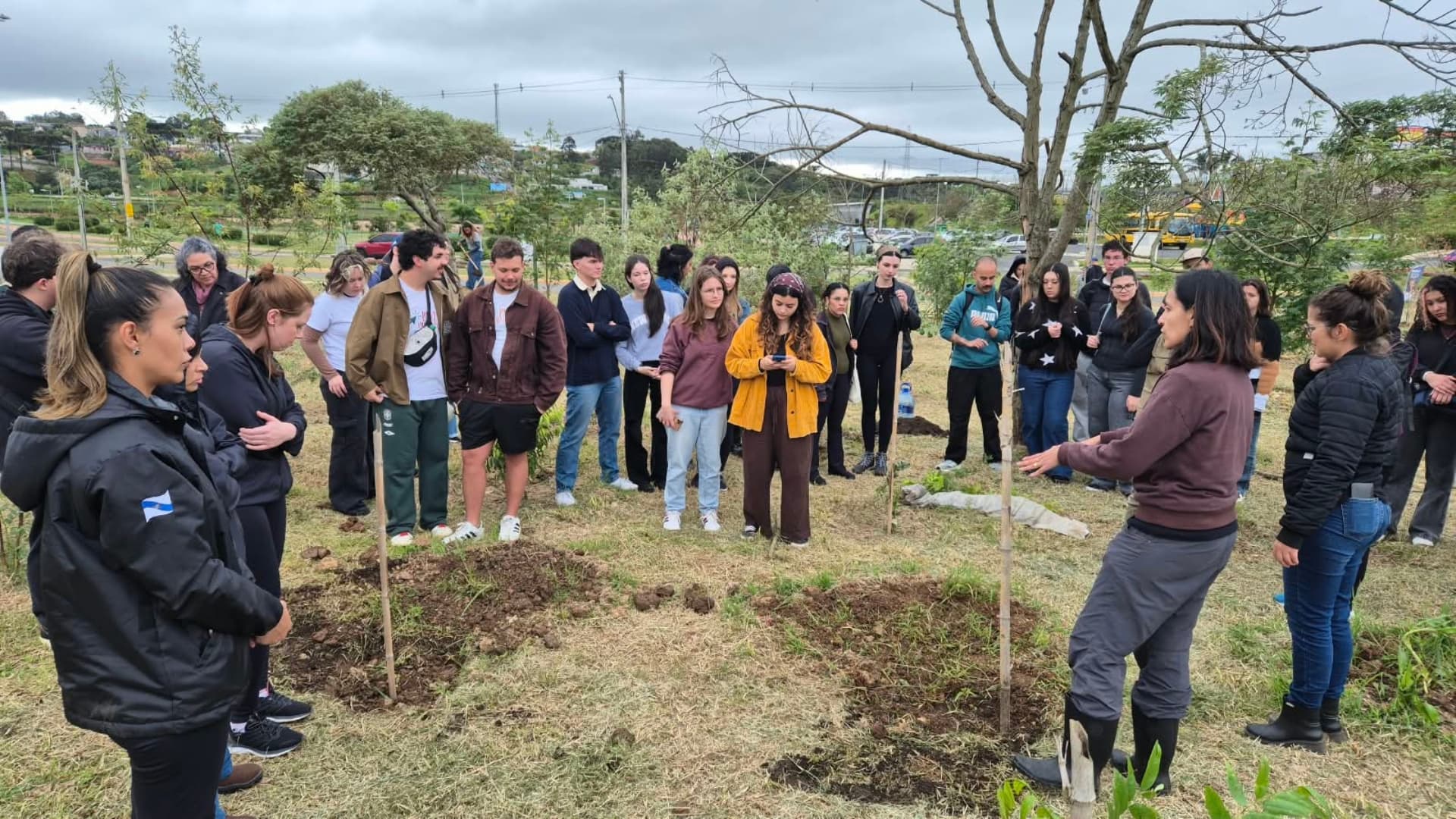
The Olarias Park received the planting of more than 300 seedlings of native species for the recovery of the area of ciliary forest of the Arroio Olarias. The initiative in reference to the Day of the Tree, celebrated today, was held on the morning of last Saturday (19) and gathered approximately 60 people. Among them, students and teachers involved in the extension projects of the State University of Ponta Grossa (UEPG), Viveiro Forestal/CAAR, Environmental Guidelines and Agency for Journalism and the Academic Center for Journalism (Cajor), as well as the Nature Conservation and Environmental Education research and extension group (Conea), the Federal Technological University of Paraná (UTFPR), with the support of the Municipal Secretariat of Meio Ambiente de Ponta Grossa (SMMA).
The action was part of the process of recomposing the vegetation on the site, already started last year with larger plants. The student of Agronomy of UEPG and member of the Forest Nursery project, Viviane Micaele dos Santos, explained that the selection of species is carried out according to the characteristics of the area: "Here, the pioneer species were chosen, which will have a faster growth, and the fruit species to foster the local fauna".
Among the species selected are: thimble, guaçatonga, araçá-do-mato, guabiroba, jerivá, cinnamon-sassafras, pine-branvo, citronella-do-mato, stick-amargo, angiquinho-rosa, stick-powder or crindiúva, caporoca, bracatinga, bracatinga-malva-Campou.
On the characteristics of the environment, in more humid areas, for example, plants adapted to soaked soils are prioritized, while places with greater drainage receive species with other characteristics of tolerance, as highlighted by the professor of the Department of Molecular, Structural and Genetic Biology of UEPG and coordinator of the Forest Nursery, Rosimeri de Oliveira Fragoso.
According to Rosimeri, the model used seeks to combine species of faster growth, able to favor the initial coating of the area, with others that present less vigorous growth, but play important functions in the ecosystem, such as the production of fruits and flowers at different times of the year. “All of this generates a great diversity of species,” he explained.
The student of Agronomy pointed out that the preparation of the soil involves different stages. The first, the opening of the pits, which was performed by Prefeitura Municipal the day before for the activity. The pits must be, on average, 50 centimeters wide, 50 centimeters long and 50 centimeters deep to facilitate the rooting of the seedlings. "Then the organic compound is mixed with the soil of the pit, in the proportion of 50%. Then, this mixture is returned to the open pit and, finally, it is necessary to carry out the fertilization of the cover," he details.
Recomposition of urban areas
For the geographer and urban architect Zingara Santos Euripe, of the Department of Environmental Engineering of the SMMA, the planting carried out in the Pottery Park integrates a model of restoration that the City intends to expand to other areas of the municipality. "This one here, the one in Arroio Ronda and the one in Parque dos Pinheiros are a model that we are implementing now. It would be the first three areas, but we want to reproduce that for the other areas that we have already catalogued," he said.
According to Zingara, the Secretariat has already identified more than 100 areas with potential to receive regeneration and restoration actions. The work carried out in the three pilot areas should serve as a reference for the expansion of the actions. “It’s been a year since we implemented this model. Let's go now to the second year. From the second year, we will have the answer of how this process took place. And then we will move on to other areas,” he said.
The recomposition of the ciliary forest is also related to the protection of water resources and the recovery of ecological functions of these areas, according to Professor Rosimeri. The vegetation contributes to water infiltration into the soil, protection of streams, conservation of native species and recovery of ecological interactions.
The restored areas can also function as shelter and feeding spaces for the fauna, in addition to contributing to the improvement of soil characteristics and the presence of microorganisms associated with vegetation, as highlighted by Rosimeri.
Handling after planting
Restoration work, however, does not end with planting seedlings in the ground. After this stage, it is necessary to carry out the monitoring and management of the area to ensure the development of the species.
Professor Rosimeri, coordinator of the Forest Nursery, points out that the growth of trees can be impaired by the presence of exotic grasses, which present rapid growth and can compete with the seedlings. "As vigorous as some trees are, they will never be more vigorous than an exotic grass, which is a frequent situation in these places. We always need a management going on, until that environment becomes self-sustaining,” he explains.
The expectation is that the area planted around the Olarias Lake will gradually advance to form a forest. Some of the seedlings planted in the winter of 2025 already show development and begin to modify the landscape of the site.
The proposal is that the recovery of vegetation also contributes to bringing the population closer to the existing natural spaces within the city and expand the perception about the importance of urban green areas, as defended by Professor Rosimeri.
"We are doing this replanting today especially in honor of the Day of the Tree, as a form of awareness for environmental education. We have all the scientific part that proves the importance of urban green areas, of the air quality in function of the plant species. And here, specifically, because it is an area of ciliary vegetation. We are on the edge of a watercourse and also contribute against erosion," said UTFPR teacher and Conea coordinator Lia Maris Ritter Antiqueira.
"We understand that, through these environmental education actions, we can bring together and raise awareness of this issue of environmental health that also leads us to think about the perspective of planetary health, which is this integration of human beings with other species, with ecosystems and with the planet that is our common home," emphasized Professor Lia.
Janaine Kronbauer, professor of the Journalism Department of UEPG, participated in the activity together with the Environmental Guidelines project and highlighted the importance of the action for the protection of meio ambiente, as well as the presence of the students of the Journalism Course of UEPG involved in the planting and journalistic coverage. "This movement of planting trees, especially native seedlings, not exotic seedlings, helps us to have a better quality of life in the future and, here, can also be an agent of propulsion, of advertising these actions to seek this education from the different publics that are served by journalism."
Urban arborization in the Olarias Park
In addition to the recovery of areas of ciliary forest, the City Council also works on the development of the Plano Municipal of Urban Arborization. The initiative should establish guidelines to identify areas with potential for new plantings and guide the tree planting in the municipality.
According to Zingara, much of the survey has already been carried out. Currently, the team is working on the definition of the next steps of the document, which should establish the guidelines for the implementation of the plan.
According to Zingara, urban forestation can produce environmental, social, psychological and economic effects. The planning should consider these different aspects in the definition of sites and planting strategies. “We know all the possible benefits a tree brings to us today. So, we just need to finish now, close this diagnosis of urban forestry so that we can have the guidelines and implement them correctly," he says.
Reporting by Amanda Grzebielucka and Pietra Gasparini, members of the Environmental Standards, extension project of the Journalism Course of UEPG
Read more: Ponta Grossa receives international lecture on entrepreneurship and innovation on Tuesday