Castro installs new Race Equality Council and elects president for 2026/2028
The Council also has R$ 87 thousand in state-approved funds to strengthen the municipal racial equality policy.

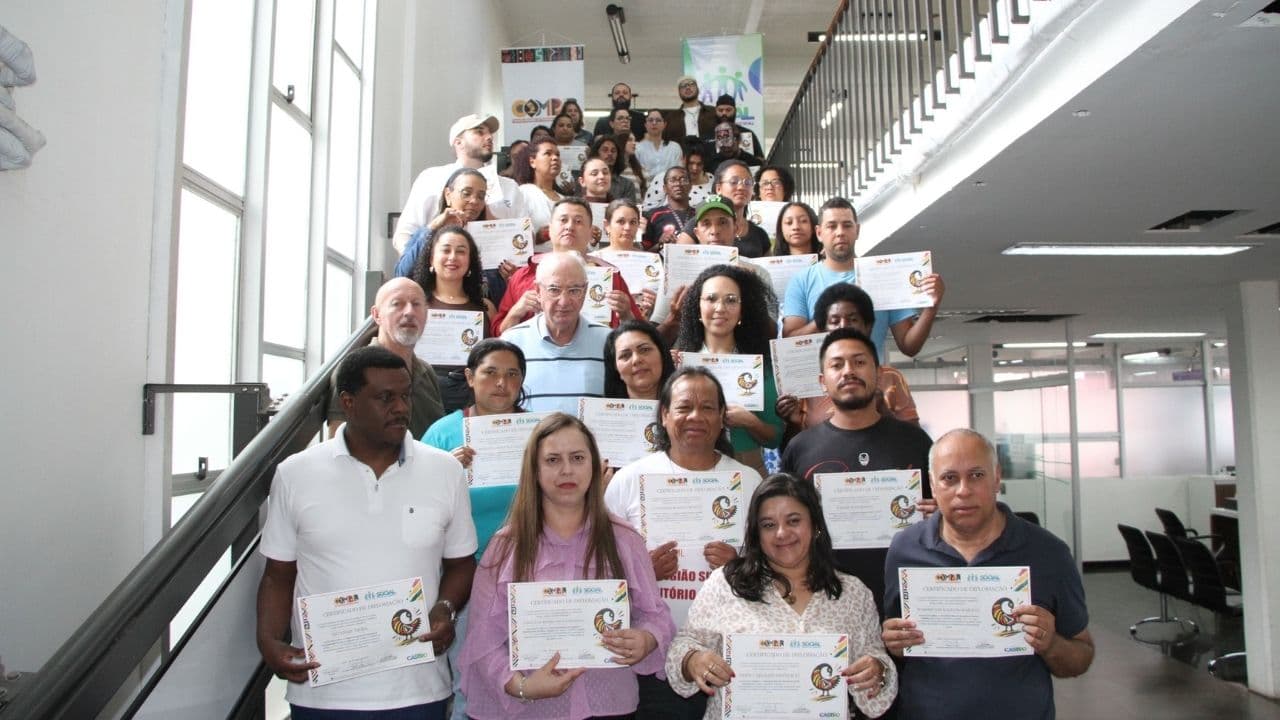
On Thursday (8), the City of Castro inaugurated the new members of the Municipal Council for the Promotion of Racial Equality (COMPIR) for the 2026/2028 management. The members were appointed by Decree No. 727/2026, signed by Mayor Reinaldo Cardoso on October 5. During the solemnity, Washington Rogeldo Marques was elected the new president of the Council.
The composition includes representatives of the public authorities and civil society. In the government sphere, COMPIR is composed of the municipal secretariats of Social Assistance, Education, Health, Industry, Trade and Tourism, Agriculture, Sport, Women and Inclusion, Public Security, Culture and Urban Development and Meio Ambiente, as well as the Superintendence of Housing and Land Regularization. In the non-governmental sphere, are represented the Association of Quilombola Communities of Castro and Adjacências, the Instituto Sorriso Negro dos Campos Gerais, the Cultural Center of Umbanda People Gypsy of the East, the Kalon gypsy community of Castro, the Ivy Iporã Indigenous Community and the quilombola communities Mamas, Limitão, Serra do Apon and Família Xavier.
Importance of the Council
On the occasion, the mayor Reinaldo Cardoso highlighted the importance of the Council for the municipality and for management. “Equality is fundamental, everyone deserves our respect. We are here today in the possession of the new Council of Racial Equality, very important for the municipality and for our management, which always considers equality a fundamental thing for all ", he said.
The mayor also announced new features for traditional communities. Among them, a new land for the indigenous community, in a place closer to the city center, and the construction of the House of Racial Equality within a tourist spot of Castro. The gypsy community will also receive a land for its final installation in a certain location. “With this, we are fulfilling our commitments and supporting the entire society in all sectors,” he added.
The Municipal Secretary of Social Welfare, Günter Lesnau, highlighted the role of councils in public administration and recalled that the Council held its first conference last year. “The Board is a fundamental entity in the administration. The mayor always prioritized the councils,” he said. Speaking about the accession to the National System for the Promotion of Racial Equality (Sinapir), the secretary stated that the process is extremely important for the raising of resources, both for the municipality and for the Council itself.
New President Speaks About New Management
For the new president, Washington Rogeldo Marques, the mission is collective. “To chair a council is a challenge, but it’s a path I take along with the other councillors, I’m not going to be doing it alone,” he said. He emphasized the importance of bringing equity to the public policies of the municipality. “I believe it is very important for the Council to have this continuity so that the municipality becomes more equal, fairer and better for all people,” he said.
Balance sheet of previous management
The former president of COMPIR, Liliane Cardoso e Silva, who was the first president of the Council, representing civil society, and remained at the head of the collegiate for two managements, made a balance of the period. She remains in the Council as a councillor and quilombola leadership, and the presidency is now exercised by the public power, as the organization set for the new biennium.
One of the main highlights of the management was access to state resources. The Paraná was the first state in Brazil to implement fund-to-fund co-financing for racial equality actions, through the State Secretariat for Women, Racial Equality and Elderly Persons (Semipi), and Castro is among the first five municipalities to implement the resource. According to Liliane, this was possible because the Council was organized and delivered the required documentation on time.
R$ 87,000 in resources
In 2025, the State Council for the Promotion of Racial Equality (Consepir/PR) approved an action plan of R$ 60,000 for Castro, formalized by COMPIR Resolution No. 7, of November 12, 2025. In 2026, a new transfer of R$ 27,000 was approved, with an implementation plan approved by Resolution No. 5, of June 19, 2026. In total, R$ 87,000 in state resources approved to strengthen the municipal policy of racial equality. “This result is the result of an institutional construction work carried out since the birth of the Council,” said Liliane. She recalled that, from 2022 to November 2025, the Council did not have its own budget and carried out its actions through partnerships with other rights councils and with the support of the structure of the Municipal Secretariat of Social Assistance.
The resources were planned for three fronts: prevention of racial violence, awareness and mobilization of the community and anti-racist training aimed at racial literacy. In the 2026 plan, R$ 27,000 were distributed as follows: R$ 5,000 for events to combat religious intolerance, R$ 15,000 for racial literacy actions and R$ 7,000 for the training of municipal councillors. The schedule foresees execution between August 2026 and August 2027.
One of the first actions carried out with the support of the co-financing was the course “Notes of Darkening”, with Plinio Camillo, in May 2026, which was attended by the Semipi team. At the time, the director of Racial Equality, Ivania Ramos, highlighted that Castro was among the first municipalities to use the resources of state co-financing. Now, part of the value will be applied in the Black Consciousness programming, in November, and in a training for the new COMPIR advisors. The plan also includes informative materials on traditional peoples and communities, awareness campaigns and cultural exhibitions.
Another milestone was the holding of the first Municipal Conference on the Promotion of Racial Equality, last year. According to Liliane, the participation was so expressive and the proposals so relevant that the demands of Castro reached the national stage, the National Conference for the Promotion of Racial Equality (Conapir). “We have been able to connect local demands to the national debate. This is an important legacy of our management,” he said.
Among the achievements, she also cited the development of the Plano Municipal for the Promotion of Racial Equality 2025/2028, the strengthening of the participation of Quilombola, indigenous, Roma and African communities and the updating of the municipal legislation, which expanded the composition of COMPIR. With the change, the Council now provides for 22 holders and 22 alternates, maintaining parity between public power and civil society. Adherence to Sinapir was referred to the Municipal Attorney General, in conjunction with the Social Assistance and Government Secretariats, and is under review.
On the news announced by the mayor, Liliane said that the House of Racial Equality can represent a reference space for welcoming, articulation, training and cultural enhancement. “The allocation of land to indigenous and gypsy communities can also represent a significant advance,” he said.
When she said goodbye to the presidency, the former president left a message to the communities and the population. “I close my presidency, but I do not close my commitment to this agenda. I will continue to contribute as an advisor and quilombola leadership,” she said. She argued that the racial equality policy is a permanent responsibility of the municipality. “A public policy is only consolidated when it ceases to depend on who is in front and becomes a guaranteed right for the population,” he concluded.
With information Advice
Read also: Investigated for supplying trafficking in Rebouças is arrested with 16 kilos of drugs