Scientists identify first known green star in the Universe
Scientists identify a green star 280 light-years from Earth. Understand the rare phenomenon and what explains its unusual coloration

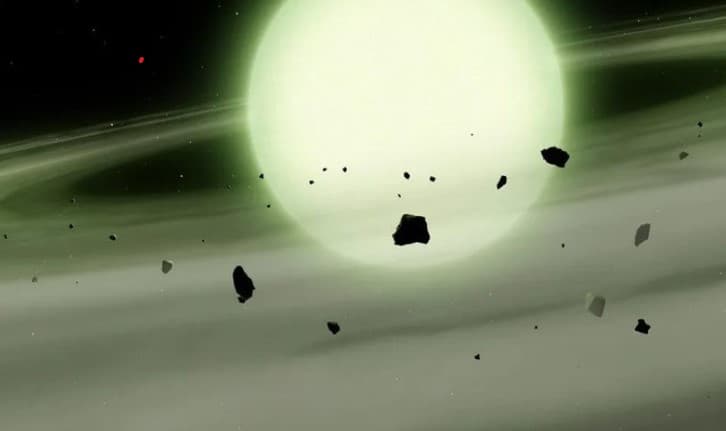
. An astronomical discovery is drawing the attention of researchers around the world. Scientists have identified a green star, considered the first known case of a star with this coloration Ci, considered the first known case of a star with this coloration. The object, named WD J1330+6435, is located approximately 280 light-years from Earth in the constellation of Dragon.
The identification was presented by researchers at the University of Warwick in the United Kingdom in a study published on October 15, 2026 in the scientific journal RAS Techniques and Instruments. The research shows that the combination of chemical elements and extreme conditions in the star’s atmosphere can produce a green-yellow hue, something that does not normally occur in ordinary stars.
University of Warwick
How can a star present the color green?
WD J1330+6435 belongs to the category of white dwarfs, celestial bodies that represent the final stage of the evolution of low or medium mass stars.
These objects arise after a star depletes its nuclear fuel and loses its outer layers, leaving behind an extremely dense core. Although they are similar in size to the Earth, white dwarfs can concentrate an amount of mass comparable to that of the Sun.
In the case of the star identified by the researchers, the explanation for the unusual color is related to the composition of its atmosphere.
Throughout its evolution, the star has incorporated rocky materials from its ancient planetary system. These debris introduced elements such as calcium, lithium and sodium into the outer layers of the star.
Due to the high atmospheric density, the atoms of these elements began to interact differently with the light emitted by the star.
Sodium, for example, typically absorbs a narrow band of orange light. However, under the extreme conditions found in the white dwarf, this absorption spreads over a larger range of the spectrum, reaching mainly yellow, orange and red tones.
Calcium also contributes to the absorption of some of the violet light. As a result, the remaining light acquires a greenish appearance.
Discovery could change understanding of the colors of stars
According to astrophysicist Mark Hollands, who led the study, the chemical composition of white dwarfs can cause surprising changes in their colors.
The research indicates that, unlike most stars, whose appearance depends mainly on temperature, some white dwarfs have hues determined also by the elements present in their atmospheres.
WD J1330+6435 has an estimated temperature of approximately 4,240 kelvins, equivalent to about 3,967 degrees Celsius.
Despite classification as a green star, the hue pointed out by the scientific models approaches the yellowish-green, known as the chartreuse.
The researchers note that the color was calculated from spectroscopic observations and atmospheric models. Therefore, it is not a direct photograph visually showing the green star.
Oxford Academic
Why is the sun not green?
The discovery also helps to clarify a question of astronomy: why do ordinary stars not show green coloration?
The answer involves Wien's law, the principle of physics that relates the temperature of a body to the range of radiation in which its emission is most intense.
Colder stars usually have reddish hues, while warmer ones may have a bluish appearance.
The Sun, for example, has a peak emission near the green region of the visible spectrum. That doesn’t mean it has that color.
Since sunlight also contains significant amounts of other colors, the combination of the different radiation bands produces a predominantly white appearance.
In the WD J1330+6435, certain chemical elements function as natural filters, absorbing specific parts of the light and allowing the green hue to stand out.
Research has also identified stars with other unusual colors
In addition to the green star, the scientists analyzed the diversity of colors presented by other white dwarfs.
Among the results is WD J1011+2845, located approximately 48 light-years from Earth, which presents a hue close to salmon rose. In this case, the coloration is related to the presence of carbon in its atmosphere.
The researchers also examined 151 white dwarfs located up to approximately 65 light-years from the Solar System. Of this total, five presented unusual colors, two being yellowish and three pink.
The results suggest that approximately one in 30 white dwarfs may have a different color than conventional white.
University of Warwick
Although WD J1330+6435 is considered the most striking example of a green star identified by the team, the study also pointed to other white dwarfs with more discrete greenish hues.
The discovery broadens knowledge about the evolution of stars and demonstrates that the chemical composition of their atmospheres can produce visual phenomena previously considered unlikely.
Trump backs off and should not recognize Flávio Bolsonaro as Brazil’s leader, Reuters says