Chinese Youth Rediscover Mao Tsé Tung 50 Years After His Death
Fifty years after Mao Tsé Tung's death, Chinese youth show fascination with the leader, calling him 'Professor' and promoting his image online. The phenomenon contrasts with the official view of the Chinese Communist Party, which acknowledges errors in his legacy.

Half a century after the death of Mao Tse Tung on September 9, 1976, the Chinese leader again gained prominence among the country’s young people. On social media, many refer to him as “Master” or “Professor”, and videos with his image go viral on platforms like Bilibili, whose user base is predominantly young — nearly 60% are between 18 and 24 years old.
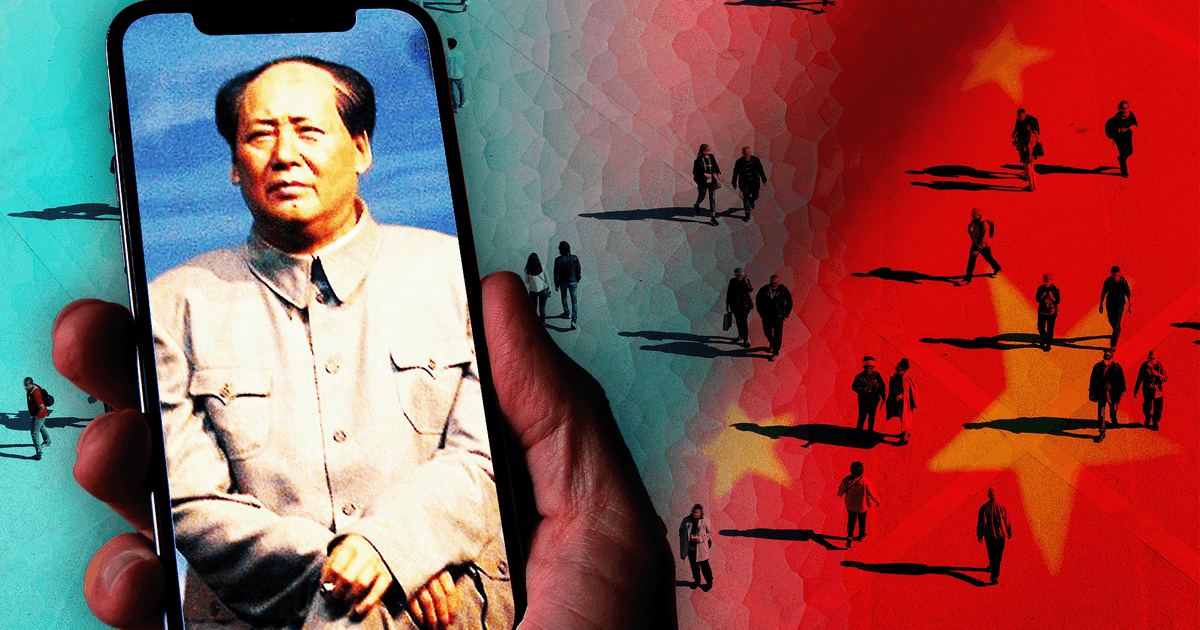
A search for "Mao Tse Tung" or "Professor" in Bilibili returns dozens of video compilations with Mao appearances drawn from movies and TV series. An image of Mao on a mobile screen, superimposed on a photo of several people walking, with shades of blue and red and hints of the Chinese flag, circulates among netizens.
Youth fascination with the 'Professor'
Dong, a student from Nanjing about to start university, is one of the young people attracted to the figure of Mao. Recently, he was moved by a video of two young women singing a patriotic song in front of a giant statue of the young Mao on Orange Island in Changsha. "They sang with so much emotion, and the statue is so tall and jovial. Seeing her, I suddenly felt quite excited,” Dong told the BBC.
The statue of the young Mao Zedong on Orange Island in Changsha, Hunan province, has become a popular tourist attraction. Many Dong colleagues participate in online communities of young people who discuss current issues, known as a “keyboard political circle.”
Renewed interest in Mao's works
Another indicator of this trend is the increase in the loan of the book "Selected Works of Mao Tse Tung". As of 2019, the work unexpectedly became the most borrowed from the Tsinghua University Library, maintaining this position every year until 2025.
It is important to note that young people’s interest in Mao today differs from the public narrative with which their parents grew up. In 1981, the Chinese Communist Party adopted a resolution drafted under the leadership of Deng Xiaoping, which established a Mao assessment balancing achievements and errors, often summarized as "70% achievements, 30% errors".
From the divine figure to the historical figure
During the governments of Deng Xiaoping and later Jiang Zemin, portraits of Mao gradually disappeared from railway stations, public squares and classrooms. People have come to see Mao increasingly as a historical figure, not as a deity, a man with limitations. Deng, in turn, became a symbol of a new economic era — a program of reforms to build an internal market economy and open it to the world.
Today, however, Mao has regained relevance to young Chinese, and many, including Dong, rarely refer to Mao by name, calling him "Professor". The American Edgar Snow is believed to have been the first Western journalist to interview Mao.
Open Discussions, but with Limits
Dong and his colleagues discuss Mao openly and bluntly. But when it comes to the current Chinese leader, Xi Jinping, Dong feels that “it’s not something that can be discussed openly.” A study by the Mercator Institute for China Studies (MERICS) found that while China’s online space still allows for some degree of public discussion, topics that actually affect the highest levels of leadership are often consciously avoided.
The phenomenon reveals a youth who seeks historical references in a context of rapid social and economic transformations. Mao’s rediscovery, albeit from a selective perspective, reflects the longings and questions of a connected generation.
Read Also
Fires in Chilean nursing home kill 16 people
Kremlin dismisses Putin-Zelensky meeting at G20
The Right advances in Latin America and echoes in Brazil
Font
www.terra.com.br