Elections 2026: see voting order and how to train
Failing 21 days for the first round, voters must prepare for the sequence of six votes on the electronic urn. The Electoral Justice offers an online simulator to train, and the paper ballot is essential on voting day.

21 days before the first round of the 2026 elections, scheduled for October 4, the Brazilian voter can now organize for the voting sequence in the electronic ballot box. There will be six elections, beginning with a federal deputy and ending with a president of the Republic. The order includes two votes for senator, one after the other, due to the renewal of two of the three seats of the Senate per state and by the Federal District, totaling 54 seats in dispute.
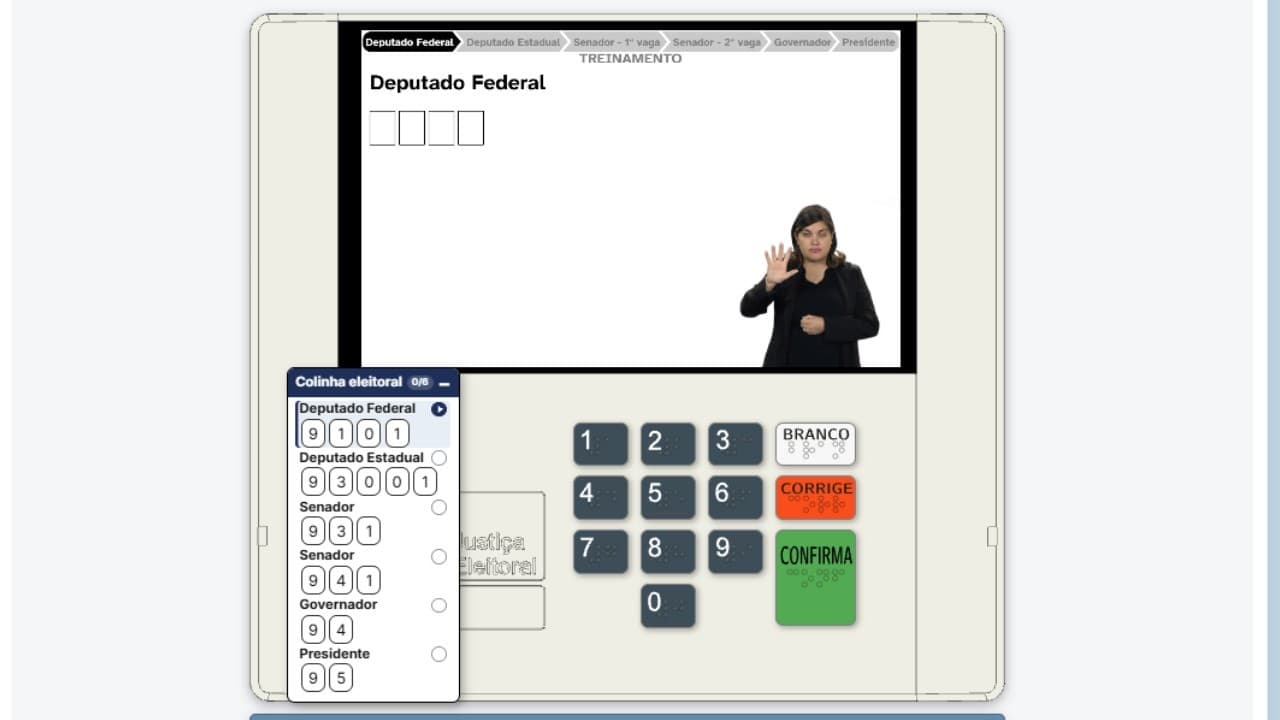
In order not to get lost when typing the numbers, the recommendation is to prepare a paper colline with the candidates in the exact order of the urn. In addition, the Superior Electoral Court (TSE) provides an online simulator that reproduces the voting stages with fictitious candidacies, allowing the voter to train before the official day.
Order of votes in the ballot box
In the first round, the elector will make six choices in the following sequence: federal deputy, state deputy (or district deputy, in the case of the DF), senator (first seat), senator (second seat), governor and president. As two seats of the Senate will be at stake, the ballot box will present two consecutive stages for the position.
In order for the two senator votes to be valid, it is necessary to choose different candidates. If the voter repeats and confirms the same name in both options, the second vote will be considered null. Therefore, the hill must reserve two spaces for the Senate, one for each candidate chosen.
How to assemble the hill
Write down the numbers of the candidates on a sheet of paper, following the sequence of the positions in the ballot box. Remember to reserve two seats for the Senate. The colline must be paper, as the mobile phone cannot be used in the voting booth and must be in the place indicated by the messiers while the voter votes.
On election day, take the colline with the actual numbers of your candidates. The simulator uses fictitious names only for training, so do not confuse the information.
Simulator of Justiça Eleitoral
The tool allows you to choose the election scenario, mount a hill for training, select accessibility features and simulate the votes. When accessing the simulator, select “General Elections — 1st round” to practice the October vote sequence.
There is a specific option for the Federal District, where the choice is for district deputy. The page also offers other scenarios, such as second round, overseas voting and municipal elections. You can also use the “Generate Example” button to fill the list automatically.
Step by step training
After selecting the scenario, the user can mount their fictitious colla or generate an example. The names and numbers of this step are fictitious and serve only for simulation. To vote on Election Day, prepare another column with the numbers of the actual candidates you have chosen.
The user can choose whether to hear the voice of the urn during the simulation. The appeal informs the position in voting, the numbers entered and the name of the chosen candidacy. In the last stage, the virtual urn and the hill mounted during training appear. Enter the numbers and check the data before confirming each vote.
A bar at the top of the screen shows the sequence of posts, helping to track the progress of the vote. This practice reduces errors and speeds up the process on the official day.
Second round and particulars
The second round is scheduled for October 25 and will only take place for positions whose dispute is not defined in the first. If there is only one pending dispute, the voter will vote only for that position. The source did not detail which positions could be second-round, but historically they are president and governor.
For the voters of Ponta Grossa and Campos Gerais, the preparation is the same: train in the simulator and take the paper collet. The region will have candidates for federal, state, senator, governor and president, all in the order indicated.
With the election approaching, it is worth dedicating a few minutes to the simulator to familiarize yourself with the urn. On October 4, the vote will be faster and safer. Keep following the Boca no Trombone for more information on the 2026 elections.
📄 Related Documents
📎 Download the 2026 polling ring to print. (Electoral%2520-%2520ColaElei%25C3%25A7%25C3%25B5es%25202026.pdf)
Read Also
STF judges report on Moraes and Vorcaro on Tuesday
DF Government asks STF return of R$ 12 billion to BRB
Fachin takes over reporting of the Master and INSS cases
Font
g1.globo.com
Access the voting simulator of Justiça Eleitoral (www.tse.jus.br)
Download the 2026 election ballot to print. (www.tre-sp.jus.br)