Ministry of Education studies end of 100% EaD bachelor's courses
The survey showed that less than 50% of students know the basics in mathematics and sciences

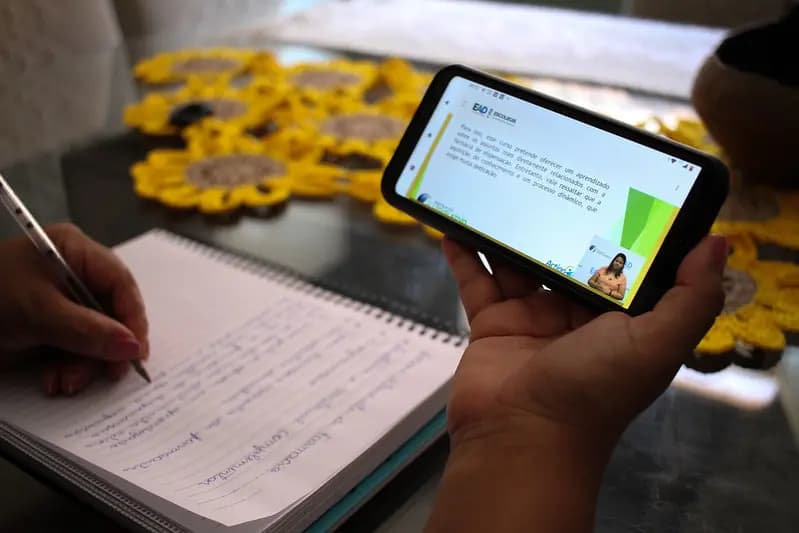
Education Minister Camilo Santana said on Tuesday that the federal government is considering banning undergraduate courses from having 100% of the workload in the distance learning (EaD) modality and plans other changes in the online teacher training.
For the minister, the time is to evaluate the non-presence degree courses, which in November had the authorizations for new 100% EaD courses suspended for 90 days. “The idea of the ministry is not to allow more courses always EAD. So let’s define if it’s going to be 50%, 30% [of the workload].”
The concern about the training of Brazilian teachers was expressed by the minister in a press conference, shortly after the presentation by the Organization for Economic Cooperation and Development (OECD), on Tuesday morning, of the results obtained by Brazil in the International Student Assessment Program (Pisa) 2022. The survey showed that less than 50% of students know the basics in mathematics and science.
Pisa 2022
In this edition of Pisa, the evaluation of educational performance analyzed the responses given by 15-year-old students from 81 countries to questions of mathematics, reading and science, contextual indicators related, among others, to the impacts of the COVID-19 pandemic on education, family relationship with students, teachers and students, and violence in schools. In Brazil, the application of Pisa to about 10,000 students was the responsibility of the National Institute of Educational Studies and Research Anísio Teixeira (Inep), linked to the MEC.
The Minister stressed the importance of the international program for Brazil in the long term. “We have at Pisa an important tool as a guide for political decisions of the Brazilian government. In the federation, the role of the execution of the educação básica is of the states and the municipalities. Therefore, the role of the MEC is to coordinate this process, to be the great master of this Brazilian educational policy to ensure the quality of education of Brazilian children and young people.”
By videoconference, OECD Secretary-General Mathias Cormann said he hoped Pisa would bring tools for early diagnosis and cooperation to improve Brazil’s educational quality. The Secretary-General pointed to the country as a good example.
“We have seen an unprecedented drop due to the effects of covid [19], equivalent to almost half a year of learning. Brazil, however, was one of the few exceptions where performance did not worsen. In fact, it has remained stable since 2009, yes. But the stability was impressive, especially considering that schools were closed during the pandemic, for a long time,” Mathias Cormann said.
Mathematics
In Brazil, 73% of the Brazilian students evaluated in this age group had performance in mathematics at the level below the basic level. Brazil fell 5% in mathematics, compared to the Pisa of 2018, and was in the range between 62nd and 68th position in the OECD ranking.
Globally, OECD countries recorded, on average, a 17% drop in mathematics between 2018 and 2022.
The General Coordinator of the National System of Evaluation of the Educação Básica of the Inep, Clara Machado da Silva Alarcão, points out that Brazil remained stable, while other countries had a drop in performance. “Since 2009, our performance has been considered stable. But we realize that in 2022, OECD countries recorded a significant drop and that, in Brazil, this did not happen, despite the pandemic situation that we experienced in the years before the application of the Pisa”.
In view of the low Brazilian score in the discipline, the minister Camilo Santana recognized that improving education in mathematics is a great challenge. The minister lamented that no Brazilian student has reached the highest level of evaluation of the Pisa, both in public schools and in private units of the country. “It became clear, once again, that the challenges are enormous and, above all, the challenge in the area of mathematics.”
Strategies
Camilo Santana listed a series of strategies that are being adopted by the federal government to improve Brazilian education and overcome the challenges revealed in Pisa 2022.
According to the minister, the policy of the Ministry of Education is focused on the commitment to have literate children at the right age. “Our concern, first and foremost, is the National Commitment Literate Child. A child to learn mathematics must first know how to read and write of the right age. And the evidence has already shown that.”
The minister also related other public policies under his management: full-time schools; connectivity for pedagogical purposes in all schools of educação básica; the quality of teacher training; the reduction of the repetition of the academic year of students of ensino médio and the permanence of students in schools.
“Full-time school has shown that the results have been better, the permanence of the young person in the school, the training in education of the ensino médio for the professional technical education, the guarantee of a technical training for the young person. All this has stimulated the improvement of learning in the educação básica of Brazil, but also, at the same time, improves the opportunities to reduce the age/series distortion and the evasion of our students in Brazilian schools.”
To reduce school evasion, the minister pointed out that savings for these young people will be important. “We have the largest [school] escape in the first year [of the ensino médio]. So we want to start this program from January next year. This is an important action, of course with the counterpart of school attendance and approval at the end of each academic year of the ensino médio.”
He valued the management of education by all entities of the Federation. “We do not believe in any action to improve the quality of educação básica, if it does not have the participation, commitment and contribution in the construction of this policy of Brazilian states and municipalities.”
The OECD Secretary-General highlighted the role of teacher enhancement . “We realized that only a small portion of Brazilian teachers assess that their profession is really considered valuable and increasing teachers’ salaries would also be a welcome decision.”
Vocational training
In addition to the MEC not wanting to allow undergraduate courses in the 100% distance mode, the Minister of Education Camilo Santana confirmed that the ministry has been discussing with the National Council of Education (CNE) changes in the continuing education of teachers and other changes in the national curricular guidelines of undergraduate courses. “The Enade [National Student Performance Examination] is going to change. The evaluation will be annual, rather than triennial, in relation to the degree,” said the minister.
Santana added that Enade will still have an evaluation of the supervised internships of students enrolled in undergraduate courses.
Evaluation
The Minister of Education also plans that the next edition of Pisa, in 2025, will evaluate the educational performance in each state and not only in the five regions of the country, as occurred in the 2022 edition. The objective is to enable the adoption of more punctual strategies for improvement of the area, in each unit of the federation and, thus, reduce regional inequalities.
“We need to have a larger sample to have representativeness, to ensure the assessments by state. It is not possible to do just with this sample of 10,000 students, which in the next Pisa, should be with about 40,000 or more students so that we can have a sample per Brazilian state, so that each state, each governor, each mayor can have the portrait of their state and outline their strategies to improve the quality of education.
Restructuring of the ensino médio
On the proposed workload in the bill that will define the new National Policy of Ensino Médio in Brazil, the minister clarified that before being sent to Congresso Nacional, it was widely discussed, during several months this year, with about 150,000 people from various sectors of society, including representatives of the municipal and state secretaries of education and other representative entities.
Camilo understands that Pisa is the demonstration that it is necessary to strengthen the basic disciplines of ensino médio, mainly mathematics and Portuguese. The recomposition of the common curriculum base and the workload is fundamental for us to guarantee the base for our young people in this country.”
The minister says he hopes that the restructuring of the ensino médio will not be politicized.
“I hope we can dialogue with a lot of frankness, with a lot of openness. This project is not a project of the MEC, it is not a project of President Lula, it is not a project of Minister Camilo. It is a project built with several hands, listening to teachers and students from all over Brazil.”
Security
Pisa 2022 also showed that, in Brazil, 10% of the students evaluated responded that they do not feel safe inside the classroom and on the way to the school unit.
The Minister of Education recalled that the federal government created an Interministerial Working Group in April this year [decree 11.469/2023] to prevent and address violence in schools and sent to Congresso Nacional a bill that provides for the implementation of a national security policy in the school environment.
Budgets
Finally, the Minister of Education Camilo Santana also ensured that in the public budget there will be resources from the Union to execute all the public policies aimed at education cited by him during the event. “Those projects that were placed as strategic and priority by [President] Lula will have priority in the budgets of the Ministry of Education until the end of 2026,” the minister said.
The government has made available the official results of Pisa 2022 for Brazil and the other countries assessed by the OECD.