Pastor asks STF to protect Marcola and Beira-Mar
The pastor Oséas de Campos sent a handwritten habeas corpus to Justice Minister Edson Fachin of the STF, requesting the transfer of Marcola and Beira-Mar to secret locations. He feared kidnapping by the CIA after the US classified PCC and CV as terrorists. Fachin rejected it due to illegitimacy and lack of jurisdiction.

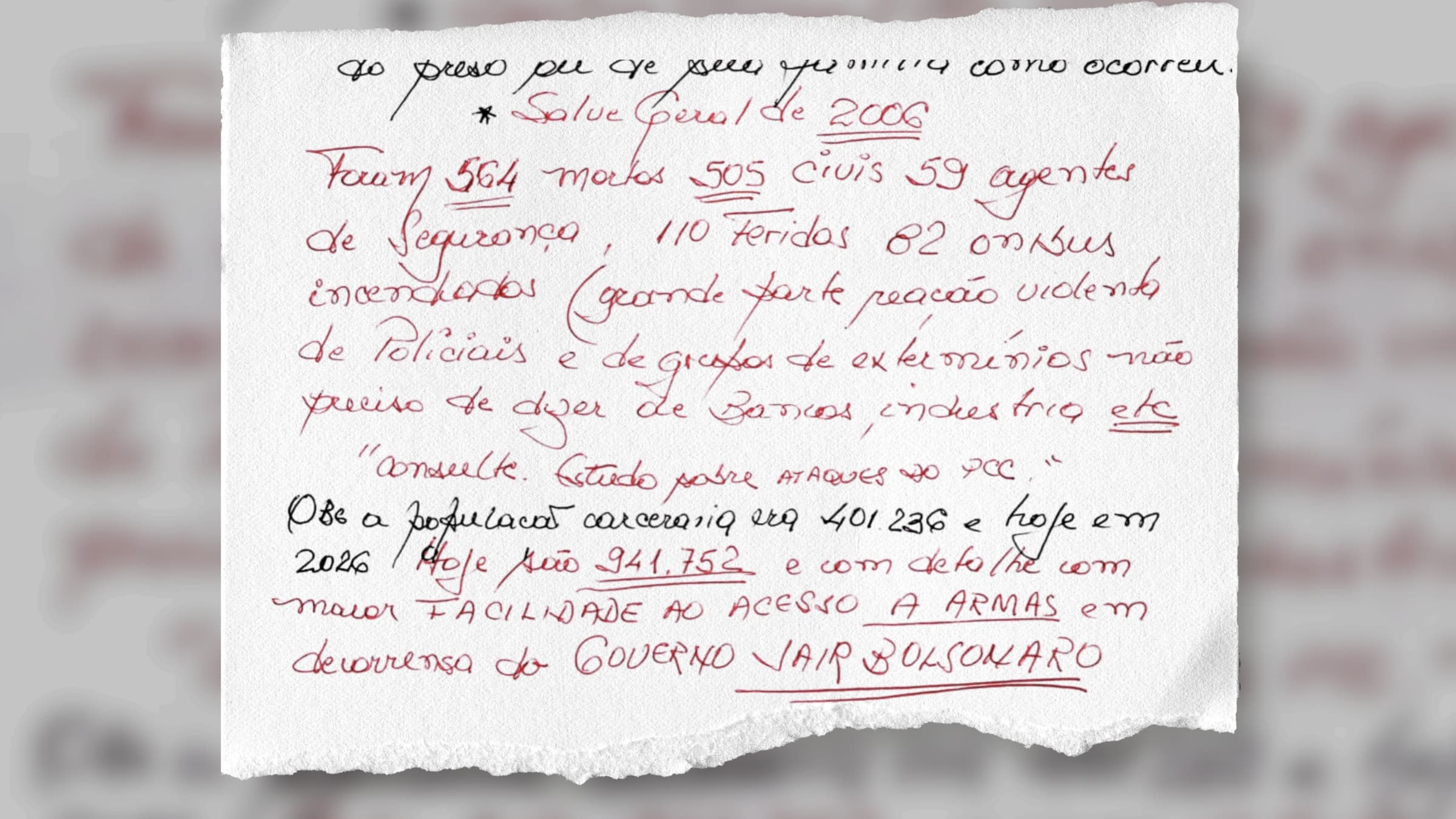
Pastor Oséas de Campos filed a manuscript habeas corpus in Supremo Tribunal Federal (STF) requesting the transfer of the faction leaders Marcola and Fernandinho Beira-Mar to secret locations. The request, addressed to Minister Edson Fachin, was presented in June 2026, after the Estados Unidos classified the First Capital Command (PCC) and the Red Command (CV) as terrorist organizations. The cleric argues that there is a real risk of the two prisoners being kidnapped by agents of the CIA, the US intelligence agency.
The action, written by hand, reflects the pastor’s concern with a possible foreign intervention in the Brazilian prison system. According to him, the capture of the criminal chiefs by another nation would violate the sovereignty of Brazil and the rights of the detainees, who are in the custody of the state in the process of resocialization. The case gained repercussions for involving central figures of organized crime and an alleged international threat.
Understand the pastor's request
Oséas de Campos grounded his request in fear that Marcola, leader of the CCP, and Fernandinho Beira-Mar, of the CV, would be the targets of a clandestine operation of the Estados Unidos. The classification of the factions as terrorists, announced by the US government, would have paved the way for direct actions of the CIA in Brazilian territory, in the view of the religious. He did not present any concrete evidence of a kidnapping plan, but he relied on the change of international stance.
The pastor also cited the risk of a “general salute” — a broad order sent by faction leaders for coordinated attacks — if the chiefs were captured. He recalled the 2006 episode in São Paulo, when the transfer of hundreds of prisoners provoked rebellions in 74 prisons and violent attacks on the streets. For Oseas, the repetition of this scenario, now with external motivation, would be catastrophic.
Context of violence and fear
The religious pointed out that the Brazilian prison population is approaching one million people in 2026, a number that expands the potential for adherence to an eventual rescue. In addition, he mentioned the facilitated access to weapons inherited from previous policies, which would make the attacks even more lethal. The combination of these factors, according to the pastor, would result in unprecedented destruction in cities and states.
The mention of the 2006 episode serves as an alert: at the time, the São Paulo capital lived days of terror, with buses burned and attacks on public buildings. Oséas believes that foreign intervention could trigger a similar reaction, but on a national scale. He did not detail how the transfer to secret locations would prevent CIA action, limiting himself to asking for protection from prisoners.
Decision of Minister Fachin
Minister Edson Fachin rejected the request for fundamental technical and legal issues. First, he noted that the pastor pointed to the Estados Unidos government as the author of the alleged threat, but the STF can only judge acts committed by Brazilian authorities under its jurisdiction. Thus, the court would have no jurisdiction to prevent a foreign action.
In addition, Fachin understood that the pastor is not a legitimate party to act in the case, especially since the prisoners cited already have constituted defenses. Justice prevents unauthorized third parties from submitting parallel applications that may interfere with the defendants’ official legal strategies. With this, the habeas corpus was archived without analysis of merit.
What the law says
In Brazilian law, habeas corpus is an instrument to protect the freedom of movement of those who suffer or are threatened with violence or coercion. However, to be accepted, the request must be made by the person himself or by someone with legitimacy, such as a lawyer or family member. The pastor does not fall into these cases, which motivated the rejection.
Fachin’s decision follows the consolidated understanding of STF that one cannot admit “apocryphal habeas corpus” or of third parties without ties to the prisoner. The measure aims to avoid overloading the judiciary with unfounded actions and preserve the autonomy of the official defense. The minister did not comment on the merit of the fear of abduction, limiting himself to procedural aspects.
Repercussions and next steps
The case rekindles the debate on national sovereignty and the actions of foreign agencies in Brazil. Experts heard by the report — who preferred not to identify themselves — claim that the classification of factions as terrorists by the US may have diplomatic unfoldings, but does not automatically authorize CIA operations on Brazilian soil. Itamaraty did not speak out about the pastor’s request.
For the Marcola and Beira-Mar prisoners, the decision maintains the current situation: both remain in custody in federal maximum security prisons, with no transfer planned. His defenses did not rule on the religious's habeas corpus. Pastor Oséas de Campos, for his part, did not inform whether he intends to appeal the decision.
The Boca no Trombone Portal will continue to follow the case and bring updates on any developments in the STF or on the international stage. Meanwhile, the debate on public security and sovereignty remains on the agenda, especially in the face of growing factions and external pressure.
Read Also
OAB-RJ defends Rodrigo Fux after message leak
Lula will walk with João Campos in Recife
Lula called Bolsonaro ineligibility in 2022 after Bolsa Família increase on the eve of the election
Font
www.gazetadopovo.com