Senate approves end of 6x1 shift schedule and reduction of work hours
PEC obtained 75 favorable votes in two rounds of voting

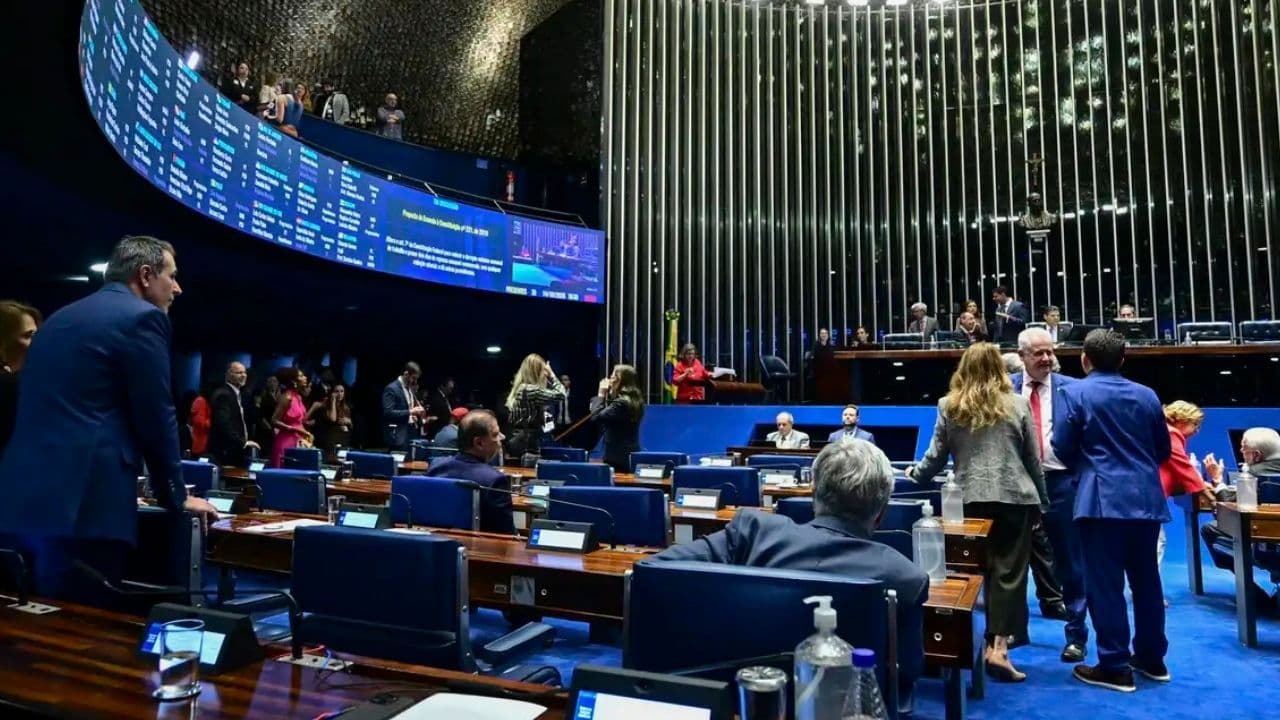
In a historic decision, the plenary of the Federal Senate approved on Wednesday night, in a two-shift vote, the Constitutional Amendment Proposal (PEC) 221/2019, which ends the 6x1 scale of work, that in which the employee works six days for one off in the week.
There were 75 votes in favor of the PEC and only one against, in both rounds.
The quorum required for a constitutional amendment was at least 49 votes in favor. The number of parliamentarians with registered presence in plenary reached 77 of the 81 senators, according to the voting panel.
The text provides for compulsory paid rest of two days a week, on a maximum day of 5x2, without salary reduction, and also reduces the current working day from 44 to 40 hours a week, with a total transition rule of 14 months.
The change represents a milestone in the struggle for labor rights since the 1988 Constitution, when the workday was reduced from 48 to 44 hours per week, and grants an extra day of rest so that workers with signed wallets can rest, extend family life and have more time for leisure and studies.
60 days after the promulgation of the constitutional amendment, companies must adopt the 5x2 scale and reduce the maximum working time to a maximum of 42 hours per week. After another 12 months, the journey will be reduced to 40 hours per week.
"I am sure that since the 1988 Constituent Assembly, this is the greatest achievement of Brazilian workers," said Senator Omar Aziz (PSD-AM), rapporteur on the matter in the Legislative House.
He kept the same text approved by the deputies five months ago, so that the proposal will not need to return to the House and can go directly to the promulgation.
The first and second rounds of voting on the same night were possible after the approval, in a symbolic vote, of a special calendar request, made by party leaders, which exempted the requirement of new deliberative sessions for the analysis of the proposal.
Approved by the Chamber of Deputies in May, the PEC reached the Senate in August, where it passed the Constitution and Justice Commission (CCJ) and was taken to the debate in plenary last week, after a compromise signed by the president of the House, Davi Alcolumbre (União-AP).
Debate in plenary
The deliberative session began shortly after 2 p.m. and extended until around 10 p.m., when the result of the vote was revealed. Practically all the senators who went up to the rostrum declared themselves in favour of the proposal, even with punctual criticism.
“We are writing this chapter alongside every worker who wakes up before the sun rises, every mother and every father who wants to follow the growth of their children, who wants to study, take care of health, find friends, be with family or rest,” said Senator Tereza Leitão (PT-PE), leader of the government in the Senate.
“The 44-hour week has been in force since the 1988 Constitution and no longer reflects the reality of the world of work, profoundly transformed by technology, automation, new norms and forms of productive organization,” commented Senator Eduardo Braga (MDB-AM).
Citing data from the Ministry of Labour and Employment (MTE) and the Brazilian Institute of Geography and Statistics (IBGE), Senator Leany Lemos (PSD-DF) highlighted that 36.2 million signed work bonds have contracted hours of more than 40 hours per week in Brazil, which equates to almost 80% of the celebrity bonds analyzed.
"That is, only 20% of formalized workers in the country do not work on the 6x1 day. These data allow us to scale the scope of the reduction of the journey and identify the sectors most affected," he said.
Even in favour of PEC, Senator Astronaut Marcos Pontes (PL-SP) warned about the risks of the measure increasing the cost of labor and causing impacts to micro and small companies, which hire a good part of the workforce that acts on the 6x1 scale.
"We cannot allow this achievement to become, in the medium and long term, detrimental to those we want to protect," he said. Despite being opposed to the proposal throughout the debate, the Partido Liberal (PL) freed the bench for the vote.
Sen. Vanderlan Cardoso (PSD-GO) said he has eliminated the 6x1 scale in his companies, which has expanded the supply of labor and increased productivity.
"The only way we have found to solve the labor shortage, which has plagued this country for many years, is not now, was to flexibly end this journey, which has been happening in our companies for more than 5 years," he said.
Millions of beneficiaries
A survey of the Institute of Applied Economic Research (Ipea), prepared based on data from the Annual Report of Social Information (RAIS), pointed out that 80% of the links with days exceeding 40 hours per week had contractual wages of up to two minimum wages (currently at R$ 3,242). The percentage reached 90% when considering the limit of three minimum wages (R$ 4,863).
Ties with contracts of up to 40 hours a week registered average monthly remuneration of R$ 6,211.16. On the other hand, workers hired for 44-hour days received, on average, about 42.3% of this value, or about R$ 2,627.32.
Schooling is also associated with the length of the day. More than 83% of workers with full ensino médio or lower education had working hours greater than 40 hours per week. Among those with complete higher education, the proportion was 53%.
Another survey pointed out that ending the 6x1 scale and reducing the maximum working day to 40 hours per week should benefit 26.8 million workers. The number brings together 22 million formal workers, the equivalent of 54% of employees with signed portfolios, and approximately 4.8 million informal workers who currently work more than 40 hours per week.
The data are from a survey of the Intersindical Department of Statistics and Socioeconomic Studies (Dieese), elaborated on the basis of the National Household Sample Survey (PNAD) of the IBGE, referring to 2025. According to the study, more than half of Brazilian formal workers still work above the 40-hour week.
With information from Agência Brasil.
Also read: Anvisa bans slimming pens without registration sold on the internet