Ponta Grossa received Getúlio Vargas 76 years ago during campaign that marked return to Presidency
On September 18, 1950, presidential candidate returned to Campos Gerais during election campaign; according to a historian from UEPG, the visit was the third moment of a political relationship built since the 1930 coup

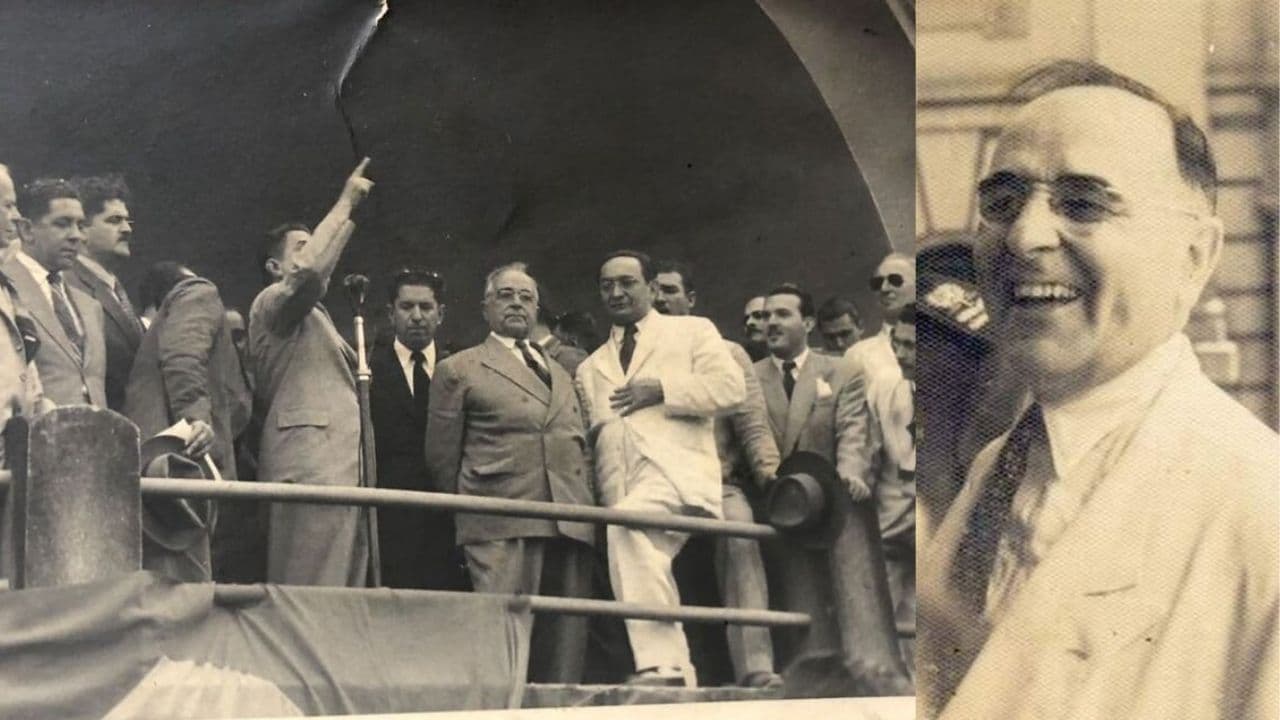
76 years ago, Ponta Grossa received one of the most important and controversial figures in Brazilian political history. On September 18, 1950, Getúlio Vargas was in the city during the campaign to return to the Presidency of the Republic. The visit, recorded in historical photographs, gathered a crowd and marked Vargas’ last pass through Ponta Grossa.
But the relationship between the Gaucho politician and the city had begun much earlier. According to Professor Paulo Eduardo Dias de Mello, from the Department of History of the State University of Ponta Grossa (UEPG), Vargas was in Ponta Grossa at three distinct moments of his political trajectory — and each visit represents a completely different phase of his relationship with power.
“He was in the city in three moments, which reveal three political facets of Getúlio,” he says. The first passage occurred in 1930, during the events that culminated in the 1930 Revolution. The second occurred in 1944, when Vargas was president and headed the country during the Estado Novo. The third, in 1950, occurred when he had already left power and was returning to the political dispute as a presidential candidate.
From revolutionary leader to presidential candidate
Vargas’ first visit to Ponta Grossa took place at one of the most decisive moments in Brazilian republican history. In October 1930, Vargas followed by train towards Rio de Janeiro, accompanied by troops and leaders of the movement that would overthrow the government of Washington Luís. Ponta Grossa, due to its strategic location and the importance of its railway structure, has become an important point for operations.
The Historical Dictionary of Campos Gerais, maintained by UEPG, records that Vargas used the military structure of Ponta Grossa as headquarters and operations center, precisely because of the strategic position of the city and the railway connection with other regions. It was also in this context that, according to Professor Paulo Eduardo, Vargas received in Ponta Grossa the news of the arrest of Washington Luís and gave orders related to the continuity of the movement.
"It was in PG that he determined decisive orders and learned of the arrest of Washington Luís, which brought him to power," he said. The Revolution of 1930 would result in the overthrow of President Washington Luís and the arrival of Vargas in command of the Provisional Government.
In 1944, Vargas returned as head of the New State.
The second visit took place in 1944, when the situation was completely different. Getúlio Vargas was already in power and ruled Brazil during the Estado Novo, an authoritarian regime established in 1937. The period would last until 1945. Historical records indicate that Vargas was again on Ponta Grossa in January 1944.
On the occasion, he participated in official activities and received tributes from the authorities and the population. The 13th Infantry Regiment held a parade in its honor on Avenida General Carlos Cavalcanti. It was, therefore, a completely different visit than 1930. If in the first passage Vargas was a revolutionary leader who advanced towards power, in 1944 he returned to the city as head of the Brazilian government.
Six years later, Vargas returned to the polls.
The third passage occurred on September 18, 1950. This time, Vargas was not president. He was a senator for Rio Grande do Sul and a candidate for the Presidency of the Republic. In the city, he was accompanied by Bento Munhoz da Rocha Netto, who was vying for the Government of the Paraná. The two would win the election that year.
The visit took place a few days before the presidential election. Vargas attended a rally at the Carlos Gomes Acoustic Shell, in the Baron Square region of Rio Branco. Photographs preserved in historical collections show the politician in front of the microphone, as thousands of people awaited his arrival in the vicinity of the square.
For Paulo Eduardo Dias de Mello, the return had a political and symbolic meaning. “His gesture was meant to symbolically capitalize on this historic link with Ponta Grossa. The return to the municipality in 1950 reinforced the symbolic link, this memory of republican history," he said. The visit was also related to the political dispute at Paraná.
At that time, Bento Munhoz da Rocha Netto was vying for the state government for a broad coalition that brought together PR, PTB and sectors of the PSD. According to the historian, there was an informal alliance between Vargas and Bento Munhoz, who shared levers during the campaign for Paraná, including the Campos Gerais.
Why was Ponta Grossa so important?
The choice of the city to receive a presidential candidate did not happen by chance. By 1950, Ponta Grossa was already one of the Paraná's main economic and railway centers. The city was a major road junction and concentrated operations and workshops of the Paraná-Santa Catarina Road Network (RVPSC).
The railway structure connected the region to São Paulo, the Pioneer North of Paraná, the Port of Paranaguá and the South of the country. This position made Ponta Grossa an important axis of movement of people and goods. “Ponta Grossa was a relevant city in the state and national scenario. The city was (and continues to be) an important junction between the road and the railway,” explains the professor.
Read also: Ponta Grossa Municipal Civil Guard receives 200 new pistols
In addition to economic importance, there was also a political and social component. The city was an important pole of workers' and trade union mobilization, especially among the railways. The rallies held in Ponta Grossa also attracted residents from neighboring municipalities, such as Castro, Palmeira and Tibagi. "Finally, it was an important attraction point for political decisions," he said.
The crowd that was recorded in the photographs
The images of September 18, 1950, help to dimension the importance of the visit. One of the photographs preserved by the collection of the Ponta Grossa Historic, from a record originally belonging to the collection of Elysio Alves de Oliveira, shows Vargas during the speech at the Carlos Gomes Acoustic Shell. Another image records the crowd that was waiting for their arrival in the Baron Square of the Rio Branco.
According to Professor Paulo Eduardo, workers, merchants and families were present. “The expression of the population in the recorded photos reveals the size and significance impact of the presence of a great political leadership,” he said. The episode also entered the political memory of the city because that would be the last visit of Getúlio Vargas to Ponta Grossa.
Vargas won the election and returned to power.
Just over two weeks after passing through Ponta Grossa, Vargas won the 1950 presidential election. That election marked his return to power after five years out of the Presidency. Vargas again assumed the government on 31 January 1951, this time in a constitutional period, after the end of the Estado Novo.
His second government was marked by the national-developmental project and by a strong participation of the State in the economy. It was during this period that initiatives occurred such as the creation of Petrobras in 1953, the creation of the National Bank for Economic Development (BNDE), the current BNDES, and the proposal to create Eletrobras.
Almost four years later, Vargas would die.
The visit of September 18, 1950, gained yet another significance over time. On that day, Vargas was starting a campaign that would take him back to the Presidency. Less than four years later, on August 24, 1954, he died at the Catete Palace in Rio de Janeiro.
Thus, the 1950 passage turned out to be not only Vargas’s last visit to Ponta Grossa, but also one of the last major records of his political trajectory before the crisis that would culminate in his death.
A story of three Getulio in Ponta Grossa
Vargas’ story in Ponta Grossa, therefore, can be divided into three moments.
In 1930, the city received the revolutionary leader who was advancing towards Rio de Janeiro and power.
In 1944, he received the president who commanded Brazil during the Estado Novo.
And in 1950, he received again the politician who sought to return to the Presidency through the ballot boxes.
For Professor Paulo Eduardo Dias de Mello, this sequence helps to explain why Vargas’ passage remains so important to the historical memory of Ponta Grossa.
The city was not just a point in the travel itinerary of one of the most important politicians of the 20th century. Ponta Grossa was present at different moments in the trajectory of Getúlio Vargas — including decisive moments for Brazilian political history.